Heavy eyelids after forehead Botox: why it happens and how long it lasts
Some people notice that their eyes feel heavy, or harder to open, after forehead Botox. This does not mean the injection went wrong. If your forehead muscle was helping lift your eyelids, that support is reduced along with the wrinkles. It usually resolves within four to six weeks.

How Botox works
Botulinum toxin blocks acetylcholine release at the nerve ending, which reduces muscle contraction. In plain terms, it stops the muscle from pulling.
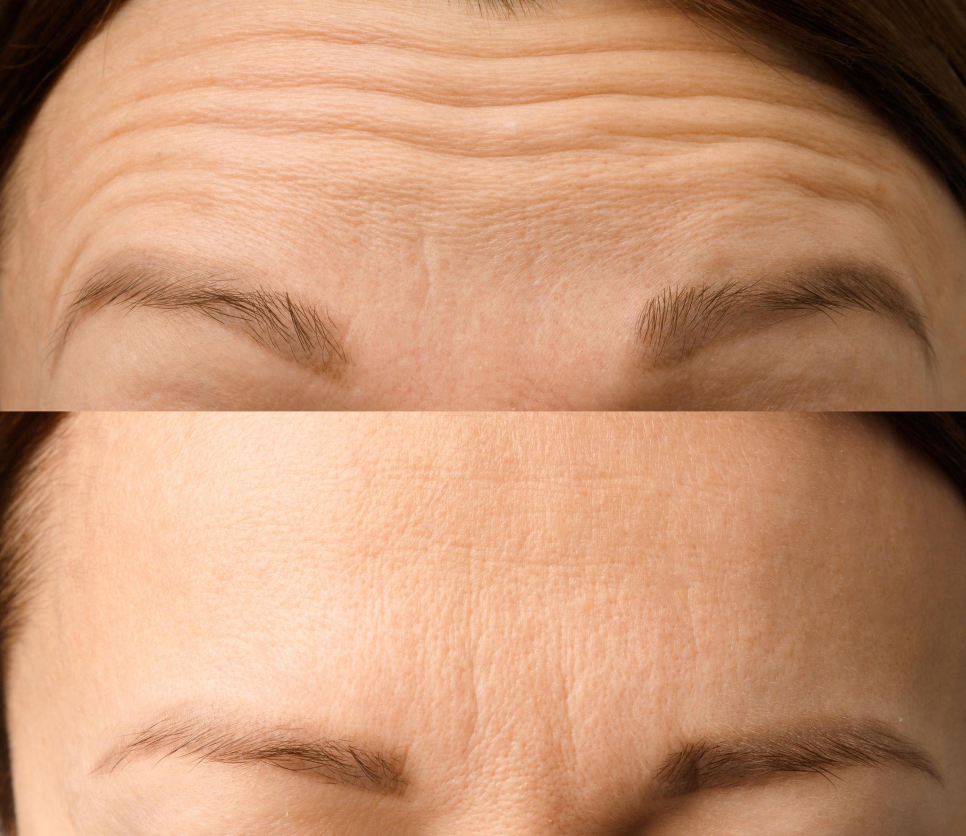
Forehead Botox reduces movement in the frontalis muscle, softening the horizontal lines caused by repeated contraction.
The frontalis is the thin muscle covering the forehead. When it contracts it pulls the eyebrows and forehead skin upward, and the horizontal lines come from that movement repeating. Forehead Botox is injected into this muscle to reduce that upward pull itself. Fewer lines and less eyebrow lift are two sides of the same effect.
More than one muscle opens your eyes
The muscle that primarily opens the eye is the levator palpebrae superioris. It does the main work of lifting the eyelid.
In some people, however, the forehead muscle is recruited as a helper:
- With increasing age
- When the eyelid skin has become lax
- When the levator muscle has weakened
In these cases, forehead Botox can leave the eyelids feeling heavy.
Why the heaviness appears
Once Botox relaxes the frontalis, the lines soften, but the same muscle also gives up the supporting role it played in opening the eye. The eyelid can feel slightly lower, and opening the eye can feel like effort.
It shows up more often in these situations:
- Age 60 and above
- A habit of raising the forehead to open the eyes
- A tendency toward eyelid droop (ptosis)
- Deep forehead lines that required a larger dose
How long recovery takes
Botox wears off gradually. As the effect fades, the heavy feeling usually improves along with it. Most people are comfortable within four to six weeks.
If the eyelid feels noticeably heavy, frequent warm compresses can help. Increased blood flow may speed recovery slightly.
If you are visiting Korea and have a flight home soon, this is worth knowing before you book: forehead Botox does not need downtime, but the heavy feeling can appear several days after the injection, once the toxin has taken effect. Ask your doctor in advance who you should contact after you return home.
Why diagnosis before injection matters
How you open your eyes, and which muscles you use, differs from person to person. Forehead Botox should be planned with all of the following in view:
- Your habit of using the forehead muscle
- The depth of the lines
- How much the eyelid has dropped
If you tend to lift your forehead to open your eyes, the dose and injection points can be adjusted so the heavy feeling is less likely.
At El:rophe Clinic, forehead Botox is not decided from the line alone. How the muscle moves is read first, and the dose and injection points are then set within the flow of the whole face. Every treatment is decided in a one-to-one consultation with the director.
Frequently asked questions
Does heavy eyelids after forehead Botox mean a bad injection?
No. If the forehead muscle was helping you open your eyes, that support is reduced along with the wrinkles. It usually resolves within four to six weeks.
When will it go back to normal?
Most people improve within four to six weeks, as the toxin effect fades and forehead strength returns.
Is there anything that helps it settle faster?
Frequent warm compresses can help by increasing blood flow. If the discomfort is severe or persists, have it checked at the clinic that treated you.
Will it happen again next time?
It can be reduced. Diagnosing forehead muscle habit and eyelid position before the injection allows the dose and placement to be adjusted. Mention it at consultation if it has happened before.
Is this the same as a drooping eyelid?
It can feel similar, but the cause is different. Heaviness after forehead Botox comes from reduced forehead support and recovers with time.
5 min walk from Seoul Nat'l Univ. of Education Stn. Exit 4 (Line 2·3)
Tel 02-533-2103