
Volume has already dropped: which lifting approach works?
A common question is which device is better — InMode, Ultherapy, Thermage. Before the device, the thing to establish is the direction in which the cheek has descended. Asking which is better is like asking whether an umbrella or boots are better in the rain. Both are for rain; they cover different things.

RF and HIFU are grouped together as "lifting" but they are different tools working on different layers, and the effect appears in different ways.
RF devices: InMode, a bipolar RF device with strengths in defining the jawline. Thermage, the original RF platform, currently in its FLX version. Oligio, Density and Tuneface are domestic RF devices at more accessible prices. Potenza and Secret are needle-RF: microneedles deliver heat directly into the dermis, so energy concentrates there without damaging the surface.
HIFU devices: Ultherapy, the original HIFU and the only device that shows the SMAS on real-time ultrasound while treating, so the operator can see the actual depth in that particular face. Shurink Universe and LinearZ are domestic HIFU devices. Lifthera 2 works in lines rather than dots and is less painful. Sonocare and Doublo Gold are dot-based.
RF works high, HIFU works deep
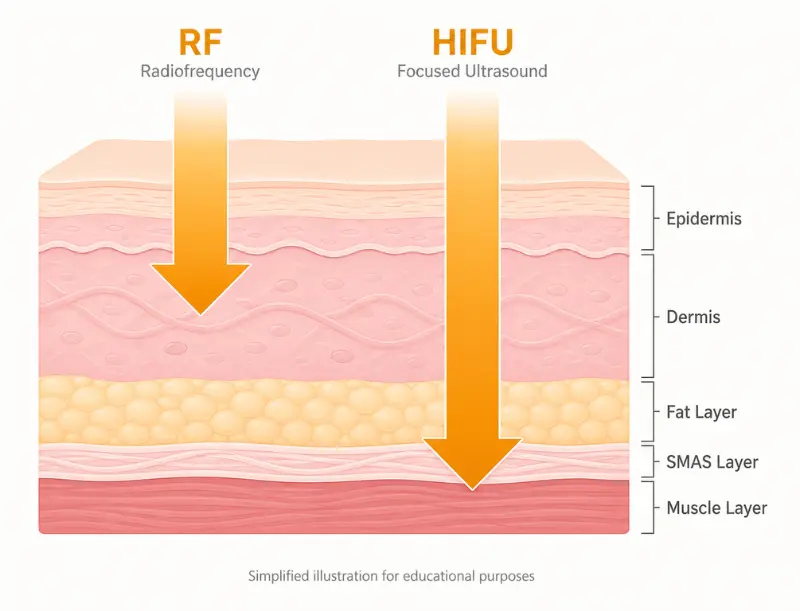
The face is layered: 1) epidermis → 2) dermis → 3) subcutaneous fat → 4) SMAS → 5) muscle. The SMAS is the main supporting layer: the one the retaining ligaments hold.
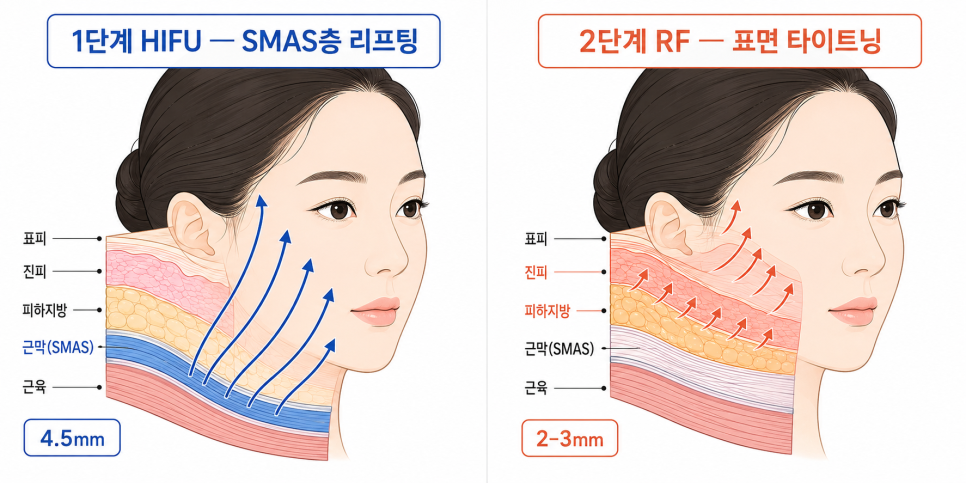
RF devices such as InMode and Thermage act on 2) the dermis and 3) the subcutaneous fat. HIFU devices such as Ultherapy reach 4) the SMAS.
How to tell which one your face needs
The reliable answer comes from an examination, but there is a rough check you can do at home. In front of a mirror, tilt your head down about 45 degrees while keeping your eyes on the mirror.
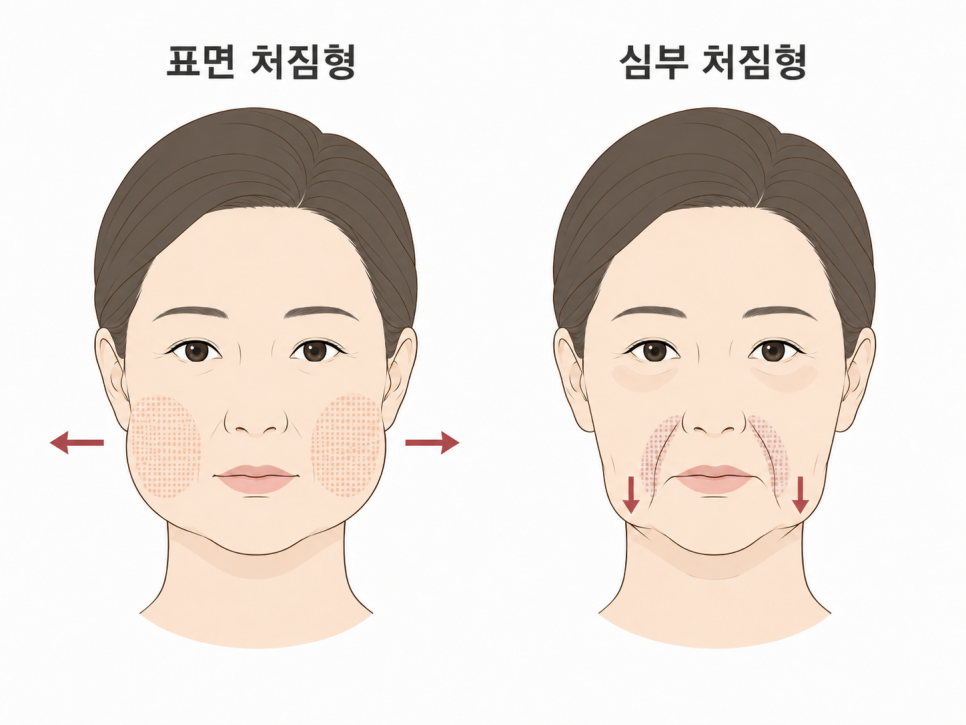
- If the jawline blurs and the cheek spreads sideways, the surface has loosened. The dermis and subcutaneous fat lost firmness first.
- If instead tissue seems to hang above the jawline and the area beside the mouth looks heavy, the deeper structure has descended. The SMAS has lost support.
In practice both usually appear together: the surface loosens while the structure underneath drops. Rather than deciding you are one type, use this to judge which is more prominent.
Many people read descending cheek volume as weight gain. In fact three changes are running at once:
- The deep medial cheek fat descends with gravity
- The retaining ligaments holding it loosen
- The SMAS itself loses elasticity
It is not the surface alone. The whole supporting structure gives way together. Korean faces are more exposed to this: where a Western face often has high cheekbones and a narrow profile with descent in one layer, a Korean face typically carries thicker fat over the cheekbone, so once the surface loosens its weight drags the deeper layers down with it. The "have I put on weight?" feeling in the mid-thirties is often the start of surface descent. Left alone, the SMAS follows in the forties.
RF is closer to ironing the surface
RF delivers heat to the dermis, the subcutaneous fat and the fibrous septa between them. It contracts existing collagen immediately and stimulates new collagen, which is why there is both a firmness right after treatment and a gradual change over one to three months.
What is less well known is that where you apply RF determines most of the result. Applied precisely to the lateral face: in front of the ear and outside the cheekbone: that area contracts and creates a lifting vector pulling the face outward and back. Applied at random across the anterior cheek it does little, and the anterior cheek volume that was carrying the face empties along with it. The same InMode produces very different satisfaction for this reason. It is a question of vector design, not the device.
RF has a clear limit: the energy does not reach the SMAS, dispersing before it gets there. Of the three causes of deep cheek descent, RF can address one or two at the surface. The third(loss of SMAS elasticity)is outside its range.
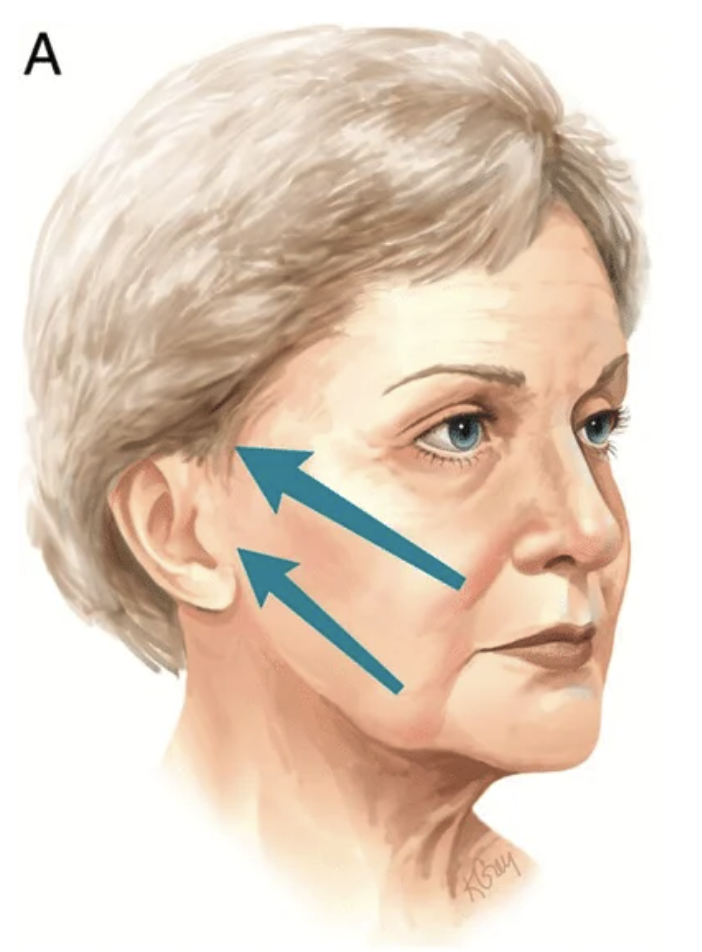
HIFU is closer to setting a pillar inside
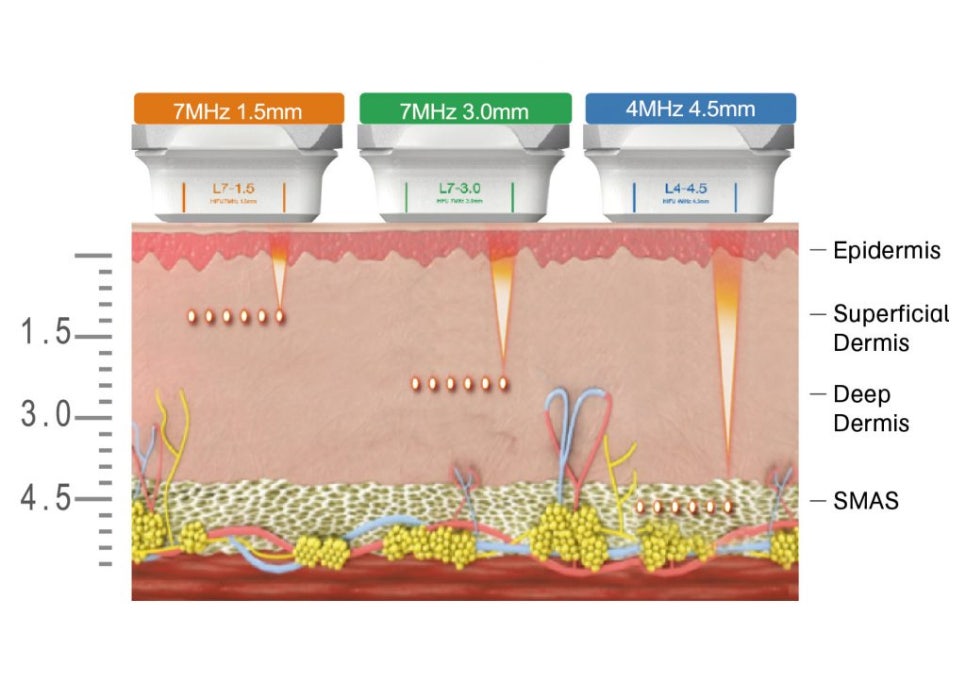
HIFU works differently. It passes through the epidermis and upper dermis untouched and creates coagulation points only at a set depth. Three depths are generally used(1.5mm, 3.0mm and 4.5mm)and 4.5mm targets the SMAS directly. The SMAS is the foundation of lifting; it has to contract for the face to be drawn upward.
A common question is whether deeper would be better. It would not. The facial nerve runs just below 4.5mm. A validated device in trained hands is designed to reach the SMAS without encroaching on it, which is what makes 4.5mm the depth that reaches the SMAS exactly while leaving the nerve beneath it alone.
The actual depth of the SMAS differs between people: thin and heavier faces differ, and so do regions within one face. This is where devices differ. Ultherapy costs more because it shows the real position of the SMAS on live ultrasound during treatment. Other HIFU devices rely on depth settings based on averages.
- RF tightens the dermis and subcutaneous fat: ironing the surface. InMode, Thermage.
- HIFU lifts the SMAS structurally: setting a pillar. Ultherapy and others.
Where all three causes are progressing at once, combining RF and HIFU is worth considering. That does not guarantee a good result on its own; operator skill and vector design matter.
Why the two are combined
Because they handle different layers, doing both together often gives a better result. But even with the same two treatments, the outcome changes with which layer is addressed first and which direction the vector is set in.
The usual order is: first HIFU on the SMAS to draw the underlying frame upward, designing the direction with an upward and backward vector centred on the lateral face rather than simply contracting tissue. Then RF over the top, focused on the temple and the outer cheekbone, which also reinforces around the retaining ligaments and settles the skin onto the structure HIFU has lifted.
One caution: the deep cheek is not treated at high intensity. Pushing the intensity there can empty the anterior cheek volume that carries the face. Most people who come in saying their cheeks have hollowed had this happen. It is a question of intensity and placement, not the device.
What matters most in lifting is establishing which layer the descent started in. For a good result, the clinical judgement of which layer to target and which direction to set the vector in matters more than the device name.
1 min walk from Dunchon-oryun Stn. Exit 1 (Line 9)
Tel 02-488-9119