
Why Ultherapy pain is reduced by treatment order rather than painkillers
Ultherapy hurts because it focuses energy point by point into a deep layer and fires those points hundreds of times across the face. It feels stronger near bone, along the jawline and cheekbones. There is no evidence that it has to hurt to work. Pain and heat right after treatment do not show that new collagen has formed, and collagen builds up over weeks to months. At Somsei Clinic the deep tissue is warmed first with RF, then 100 Ultherapy lines go only where sagging starts. The pain burden tends to go down, but the pain does not go away.

- PROFESSORAdjunct Professor, Korea University Anam Hospital (current)
- ANATOMYFacial Anatomy Program, Yale University
- ANTI-AGINGAnti-Aging Program, Brigham and Women's Hospital, Harvard
Full profileClose profile
- Adjunct Professor, Korea University Anam Hospital (current)
- Residency, Korea University Anam Hospital
- Facial Anatomy Program, Yale University
- Anti-Aging Program, Brigham and Women's Hospital, Harvard
- Member, Korean Academy of Aesthetic and Laser Surgery
Contents8
- 01Why Ultherapy hurts more along the jawline and cheekbones
- 02The myth that it has to hurt and the right range of heat
- 03The layered lifting order that uses only 100 Ultherapy lines
- 04Why Ultherapy is not pushed hard on faces with little front cheek volume
- 05Whether 100 Ultherapy lines are too few, and a split-face study
- 06Swelling and daily life the day after layered lifting
- 07Why the layer where sagging began and past lifting are checked at consultation
- 08Frequently asked questions
"Doctor, I heard Ultherapy really hurts?" This question comes up at almost every lifting consultation. People who have had it before say, "It worked well, but I keep hesitating because I remember the pain."
Others ask the opposite: "Doesn't it have to hurt to work?" To answer both, it helps to see where and how Ultherapy puts its energy.
Why Ultherapy hurts more along the jawline and cheekbones
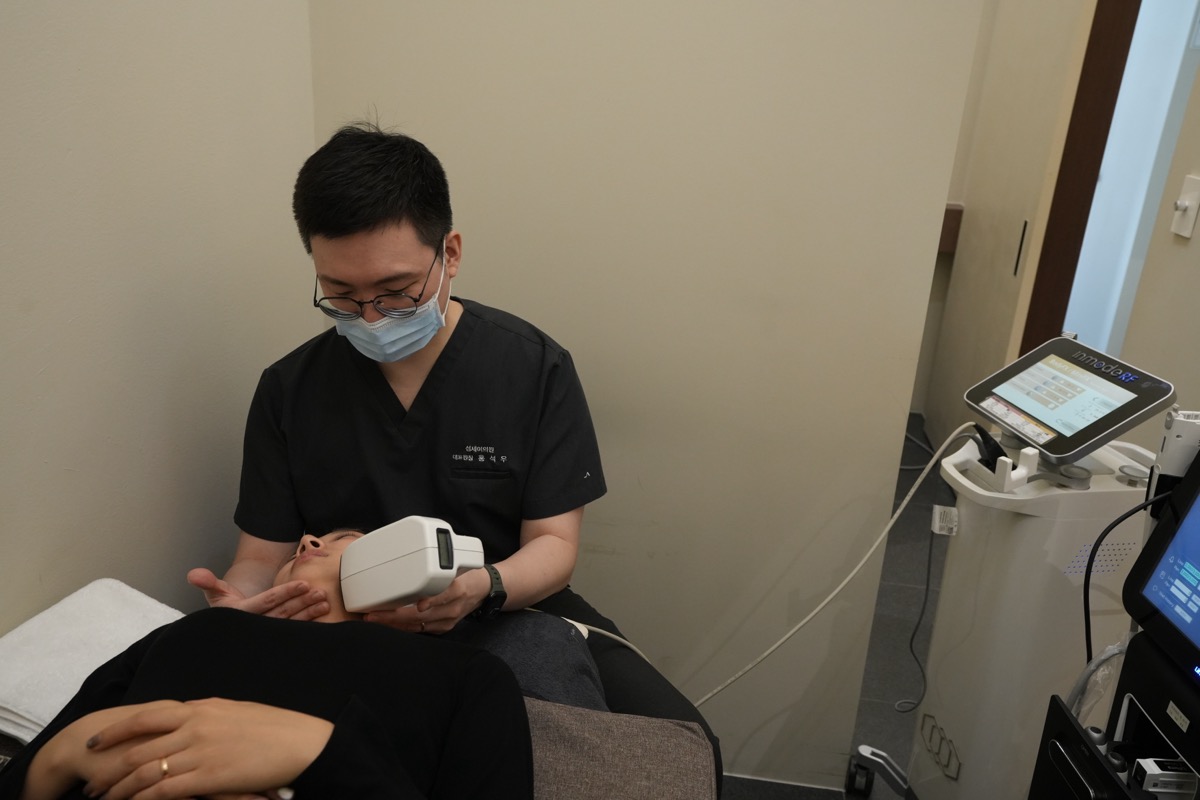
Ultherapy is a device that fires focused ultrasound point by point into a deep layer under the skin. Because the energy is gathered to reach the fascia that supports the face (SMAS), each shot feels strong.
Near bone, along the jawline or cheekbones, the ultrasound reaches the bone and the pain feels stronger. Many describe a feeling that the bone rings as it passes the jawline. Spread hundreds of shots across the whole face, and that pain lasts the whole session.
The myth that it has to hurt and the right range of heat
When asked, "Doesn't it have to hurt to work?", the answer is not necessarily. The same is said to people worried about hollow cheeks after Ultherapy. Lifting is not a treatment that gets better the harder it is done.
A 2026 commentary in an aesthetic dermatology journal took up this question. Skin starts to feel heat as pain at around 43°C, and collagen remodeling has a suitable temperature range. Too little heat may not stimulate collagen, and too much raises the burden of pain, inflammation, burns and prolonged swelling.
The commentary says swelling, heat, pain and tightness right after treatment should not be read as proof that collagen has been rebuilt, because that process unfolds over weeks to months. It also notes that a moderate temperature held steadily may be safer and more useful than a short, intense spike. It is a commentary, not a clinical trial, and it focuses on RF treatments. Ultrasound lifting is only mentioned as a related technology (J Cosmet Dermatol 2026 · PMC13425427, no PubMed ID yet).
The layered lifting order that uses only 100 Ultherapy lines
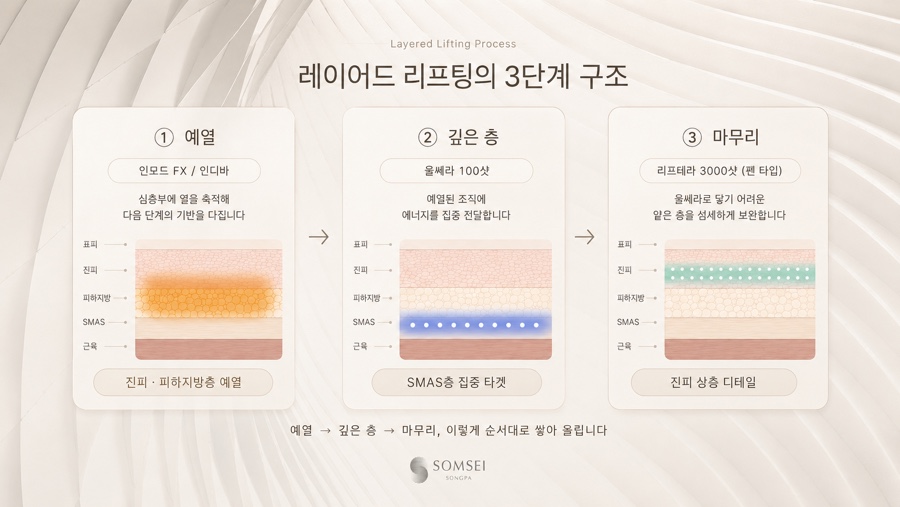
Quite a few people come in having put off lifting because of Ultherapy pain. At Somsei Clinic, instead of adding painkillers, the order of lifting was changed. The deep tissue is warmed first and Ultherapy goes only where it is needed. This order is called layered lifting.
First, InMode FX or Indiba slowly warms the deep tissue of the lower face. InMode FX is used when fat under the chin and loose tissue are both a concern, and Indiba when the need is more to settle swelling and tissue condition than to reduce fat. One of the two is chosen after looking at fat volume, skin thickness and swelling.
Next come 100 Ultherapy lines. They are not spread thinly over the whole face but gathered where sagging starts, such as below the cheeks and along the jawline. Pre-warmed tissue can give the same effect with fewer shots, so hundreds of shots are not needed. Firing Ultherapy straight into unwarmed tissue lowers efficiency for the same number of shots and makes the pain worse.
Last, Liftera pen type at 3,000 shots refines curved areas such as the chin tip and mouth corners, shallow and in detail.
With fewer shots the pain burden tends to go down. The pain does not go away. If you are sensitive to pain, say so at the consultation, and the strength of each step is adjusted together.
Even within the same program, not everyone gets the same steps and strength. Koreans tend to have thicker fat over the cheekbones and fuller midface volume, so the same energy gives different results from person to person. Depending on facial structure and the pattern of sagging, some get a longer warm-up and others a larger share of Ultherapy.
Why Ultherapy is not pushed hard on faces with little front cheek volume
Some people come in saying, "My cheeks hollowed after Ultherapy." Looking into the cause, it is usually not the device but how the strength and location were chosen.
Contracting the deep cheek strongly can also deflate the volume of the front and middle cheek that was keeping the face lively. So Ultherapy is not pushed hard on the front and middle cheek. More care is taken with these faces:
- Faces with little front cheek volume to begin with
- Faces lacking volume in the middle of the cheek
- Faces that are thin overall
On these faces, contracting only the deep cheek hard leaves a flat, tired look rather than a smaller face. So the first question is not how many shots, but what to keep, what to tidy and what to lift.
Whether 100 Ultherapy lines are too few, and a split-face study
"Aren't 100 lines of Ultherapy too few?" This worry follows once layered lifting is explained. The 100 lines are not meant to cover the whole face; they are gathered where sagging starts, and the layers above and below are handled by other devices.
One study compared what happens when RF is added to ultrasound lifting on the same day. In China in 2025, 26 people received ultrasound lifting on the whole face, and one randomly chosen side also received microneedle RF. At 3 months, the wrinkle score measured by a skin imaging system fell by 20% on the ultrasound-only side and by 40% on the side with RF added. Pores and texture also improved more on the RF side, and over 90% of participants were satisfied (J Cosmet Dermatol 2025 · PMID 40980871).
This study cannot be read directly as a result for layered lifting. It is a small study of 26 people followed for only 3 months, and it used a different ultrasound device, not Ultherapy, with microneedle RF. The order was also the reverse: ultrasound first, then RF. It did not look at reducing the number of ultrasound shots either. It is taken only as pointing toward using different devices for different layers rather than treating a single layer.
Swelling and daily life the day after layered lifting
"I have work the next day. What if my face swells?" This worry comes up often. Right after treatment some redness or warmth may remain, and most people go back to daily life without much disruption. In the study above, some had redness, light bruising or swelling, and all of it settled without any treatment.
For a few days afterwards, avoid saunas, hot rooms, hard exercise and heavy drinking. Protect your skin from UV and keep it well moisturized. The lifting effect does not end on the day of treatment; it appears slowly over the months collagen takes to rebuild. If you are visiting from abroad, that means the result is still developing after you fly home.
Why the layer where sagging began and past lifting are checked at consultation
Many come in having tried both Ultherapy and InMode without the lines changing as much as they hoped. Hearing their history, most received the devices separately. So the dates and devices of past lifting are always asked about, and the order and strength this time are set from that history.
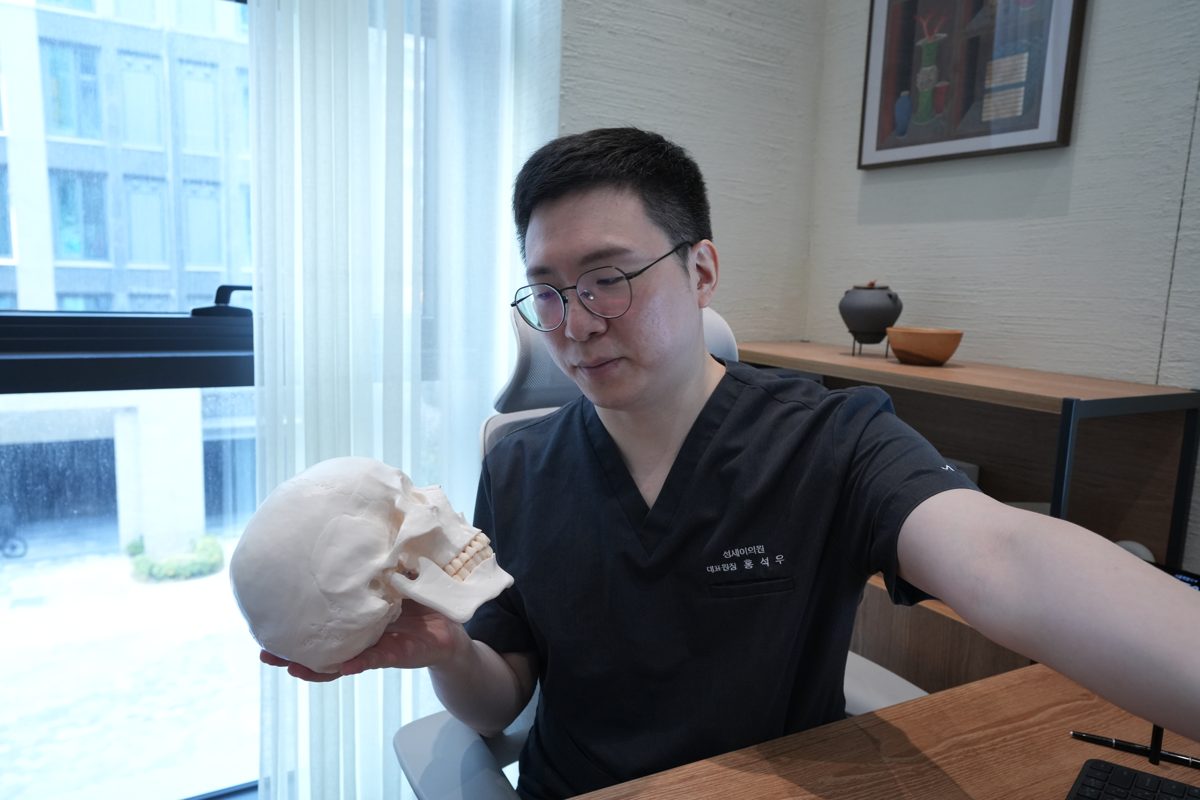
Which layer the sagging started in is checked as well. With a skull model, the layer that has come down is pointed out, and after treatment the jawline and the area below the cheeks are checked one by one in a mirror.
Using several devices together does not make it better for everyone. The first question is whether the treatment is needed for the face as it is now, and where and how strongly to apply it.
Frequently asked questions
QWhy does Ultherapy hurt so much?
It focuses ultrasound energy point by point into a deep layer and fires those points hundreds of times across the face. Near bone, along the jawline and cheekbones, the ultrasound reaches the bone and feels more painful.
QDoes Ultherapy have to hurt to work?
No. Pain and heat right after treatment are not proof that new collagen has formed, and collagen builds up over weeks to months. Too much energy raises the burden of pain, swelling and burns.
QAre 100 lines of Ultherapy less effective?
The 100 lines are gathered where sagging starts, such as below the cheeks and the jawline, not spread over the whole face. The layers above and below are handled by InMode FX or Indiba and by Liftera. This answer is not based on a study that directly compared reduced shot counts.
QIs layered lifting painless?
Warming the tissue first and using fewer shots tends to lower the pain burden. There is still pain. If you are sensitive, say so and the strength of each step is adjusted together.
QCan I go to work the next day?
Some redness or warmth may remain, and most people go back to daily life without much disruption. For a few days, avoid saunas, hot rooms, hard exercise and heavy drinking.
1 min walk from Dunchon-oryun Stn. Exit 1 (Line 9)
Tel 02-488-9119