
Why radiofrequency alone falls short on a sagging deep cheek
Cheek sagging is hard to read as stretched skin alone. The deep cheek fat moves downward, the ligaments that held it loosen, and the outline of the face gives way with them. Radiofrequency is strong at tightening the dermis and the fat beneath it, but it is hard for it to carry enough heat down to the deeper layer. Ultrasound aims at that deeper layer directly. Which is why dividing the approach by layer is steadier than turning one device up.

People come in saying the face looks heavy even though they have not lost weight. Looking in the mirror together, the middle of the cheek is hollow and the weight has gathered below it. The cheek has not grown; it has moved.
Treat a face like that by tightening the skin alone and the surface tidies up while the outline stays where it was. That is the reason for separating out what came down, and from which layer, before anything else.
The deep cheek fat thinning and moving downward
Facial fat is not one mass but a set of compartments. With age the compartments do not change at the same rate: some grow thinner while others actually thicken.
One study divided CT images of 60 Asian women by age group (J Plast Reconstr Aesthet Surg 2019, PMID 31248828). The superficial layer of the cheek fat grew thinner with age, and the inner part of the deep cheek fat tended to thin as well. And the thinner the deep cheek fat, the more marked the tear trough and the nasolabial fold.
So the cheek looks heavy from outside while it is emptying on the inside. Which is why reducing the whole cheek on the strength of the side the weight fell to takes down the part that was already emptying too.
The layer radiofrequency reaches and the one it does not
Radiofrequency lifting carries heat into the dermis, the fat beneath it and the fibrous septae running between them, so that collagen contracts and then fills back in. It is clearly effective for skin firmness and soft tissue tightening, and tightening from the outer part of the face helps set the overall direction.
There is a limit to the depth that heat travels, though. It is hard to put enough heat into the sheet wrapping the muscles that make expression. The axis that draws the structure up sits in that layer, and if you cannot reach it the surface is tidied while the outline remains.
Ultrasound gathers its energy at a point, so it can aim at the depth you want directly. If radiofrequency takes the superficial and middle layers, ultrasound is closer to taking the structure of the deep layer.
What changes when the two are used together
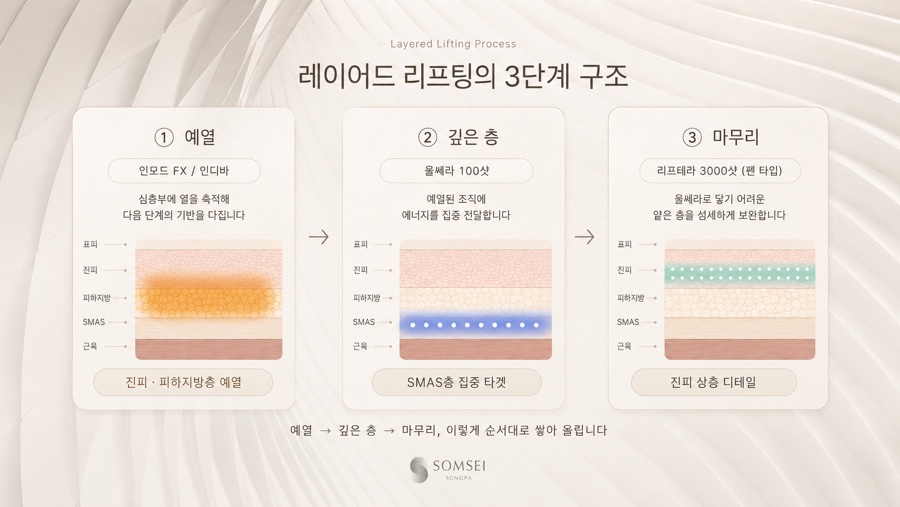
Two devices working in different layers fill in for each other. First ultrasound contracts the deep layer to build the base that does the lifting, then radiofrequency tightens the dermis and the layer below it so the skin sits close.
The order and the placing matter. With ultrasound I work out a direction heading up and back, centred on the outer face, and with radiofrequency I tidy the temple and the outer cheekbone. The deep cheek itself I do not contract heavily; I only shape the outline. Reduce a place that is already emptying and the face looks drawn.
Why volume placed in the deep layer does not slide down
I look at the layer when filling a hollow as well. In a study that checked whether material placed in a deep fat compartment ran downward (Plast Reconstr Surg 2019, PMID 30589776), increasing the volume did not move the material down. What went into the deep layer supported the structure above it and pushed it forward.
So for someone hollow at the front of the cheek I look first at where the support should sit rather than filling the surface. The same amount gives a different result depending on the layer you leave it in.
What Somsei Clinic separates out first in cheek sagging
In the consultation we look in the mirror together and separate three things: whether the surface of the skin has loosened, whether the deep layer has come down, or whether fat has moved. A different starting layer means a different depth to aim at.
A face has planes that catch the light and planes that fall into shadow. Balance is not putting the same amount into each side; it is dividing it so that how much shows comes out even. So I mark the areas on the face before starting.
For someone whose cheeks are already thin I do not raise the output in the deep layer. When loss matters more than sagging, driving heat in hard can make the face look more drawn. In that case I look at volume first.
Frequently asked questions
My cheeks have dropped. Is radiofrequency alone enough?
If the surface of the skin and the layer beneath it are the main problem, radiofrequency on its own will tidy it. Where the deep layer has come down, though, only the surface tightens and the outline can stay as it was.
My deep cheek is hollow. Will lifting hollow it further?
Driving the deep layer hard into a place that is already emptying can do that. There I look first at where support should sit and divide up the area the heat goes into.
Can I have radiofrequency and ultrasound on the same day?
They work in different layers, so they are often used together. The order and the placing are set in advance, and depending on the state of the skin I sometimes split them across visits.
If I reduce the cheek, does the sagging sort itself out?
Where the weight has fallen downward, I look at lifting before reducing. The front of the cheek and its centre have to be left alone for the face to look bright.
When does the result start to show?
The points ultrasound makes fill back in with collagen over months. I tend to look at where things stand two or three months later, rather than straight after, and set the next plan then.
Is one session the end of it?
The layer the sagging started in and the response to the first session differ from person to person, so it is not settled in one go. I watch how it goes and adjust the next session and the depth to aim at.
1 min walk from Dunchon-oryun Stn. Exit 1 (Line 9)
Tel 02-488-9119