
Botox for underarm sweating: why results differ
Excess underarm sweating has a name — hyperhidrosis — and botulinum toxin treats it reasonably simply. What decides the result is less the dose than how shallow and how evenly it is injected.

- PROFESSORAdjunct Professor, Korea University Anam Hospital (current)
- ANATOMYFacial Anatomy Program, Yale University
- ANTI-AGINGAnti-Aging Program, Brigham and Women's Hospital, Harvard
Full profileClose profile
- Adjunct Professor, Korea University Anam Hospital (current)
- Residency, Korea University Anam Hospital
- Facial Anatomy Program, Yale University
- Anti-Aging Program, Brigham and Women's Hospital, Harvard
- Member, Korean Academy of Aesthetic and Laser Surgery
Contents5
How it reduces sweating
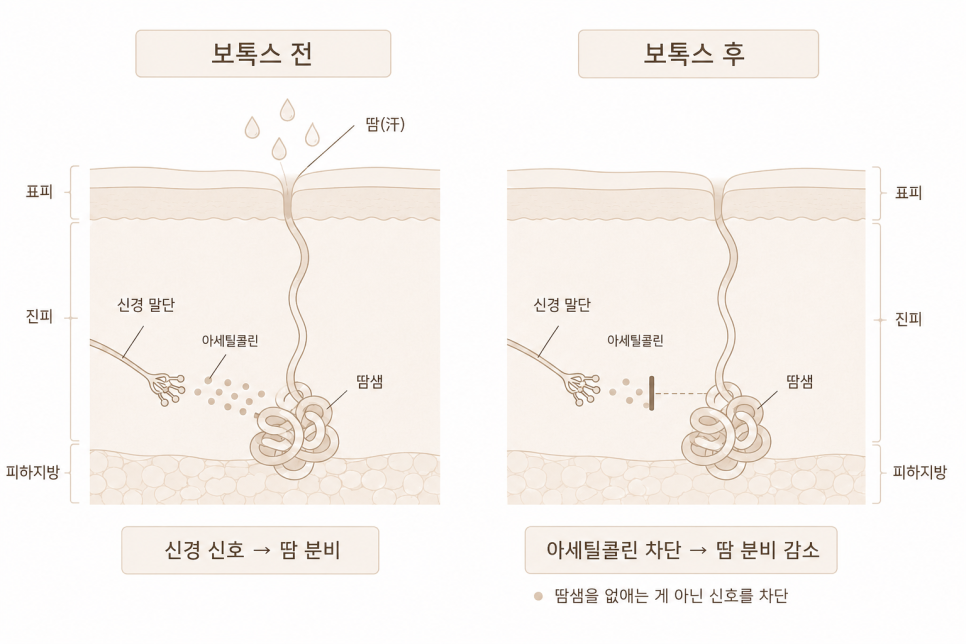
Sweat glands release sweat in response to nerve stimulation. Acetylcholine is released at the nerve ending and carries the signal to the gland. Botulinum toxin blocks that release: it cuts the signal to the gland.
People often ask whether it removes the sweat glands. It does not. The gland stays; only the instruction to sweat is blocked.
Dose and onset
Around 100 units in total is most common for the underarms, usually 50 units per side divided across multiple points. The dose is not fixed: it is adjusted for severity, build and previous response, and 50 to 100 units may be used.
Why depth decides the result
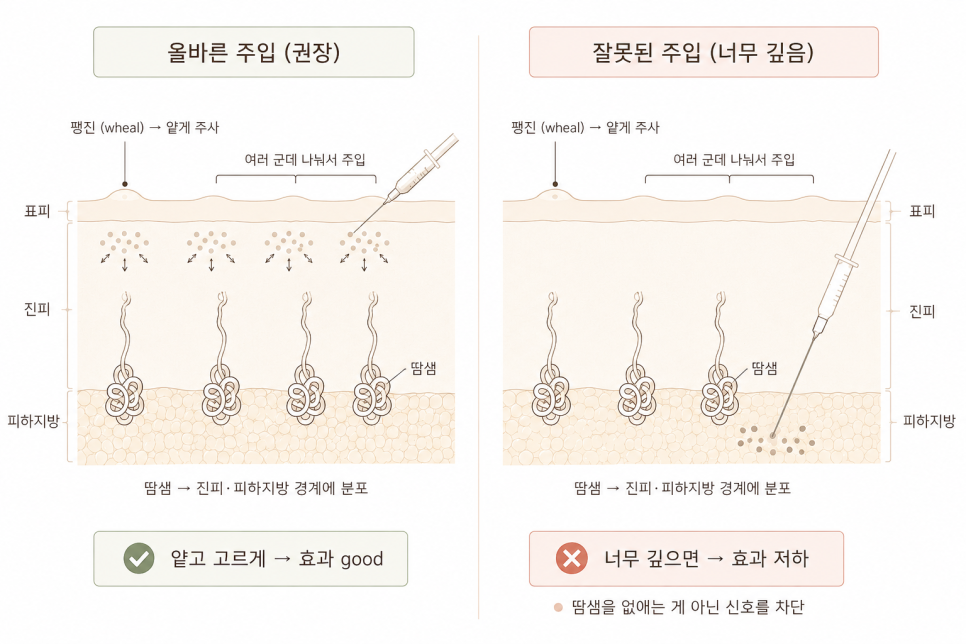
Sweat glands sit at a particular depth, at the boundary between the deep dermis and the subcutaneous tissue. Injected too deep, the drug enters a different layer and the effect falls short.
So it is injected shallow, in small amounts just under the skin: often shallow enough to raise a small wheal on the surface: and divided across many points so it spreads evenly at that boundary.
With the same toxin, the result varies with the depth injected, how finely the points are divided, and how the pattern of sweating was assessed beforehand.
Timing and duration
The procedure takes about 10 to 15 minutes. The effect starts to appear three to seven days later and generally lasts four to nine months, with individual variation.
Frequently asked questions
QDoes it hurt?
The underarm is relatively low in pain, though dividing the injection across many points means some stinging. Numbing cream can be used.
QDoes it destroy the sweat glands?
No. It blocks the signal, not the gland. When the effect fades sweating returns, and the treatment is repeated.
QWill I sweat more elsewhere?
Underarm output falls; sweat does not transfer elsewhere. Some people notice sweat in other areas relatively more, which is worth discussing at consultation.
QWhen should I have it?
The effect starts at three to seven days, so before the hot season or about two weeks before an important date.
1 min walk from Dunchon-oryun Stn. Exit 1 (Line 9)
Tel 02-488-9119