
How to reduce Botox resistance and when to have the next injection
A drop in Botox effect is not always resistance. With cosmetic Botox, resistance is rare, at about 1 in 200 people. Even so, I always stick to two things: no large amount at once and no repeat injections at short intervals.

- PROFESSORAdjunct Professor, Korea University Anam Hospital (current)
- ANATOMYFacial Anatomy Program, Yale University
- ANTI-AGINGAnti-Aging Program, Brigham and Women's Hospital, Harvard
Full profileClose profile
- Adjunct Professor, Korea University Anam Hospital (current)
- Residency, Korea University Anam Hospital
- Facial Anatomy Program, Yale University
- Anti-Aging Program, Brigham and Women's Hospital, Harvard
- Member, Korean Academy of Aesthetic and Laser Surgery
Contents10
- 01Muscle Botox and skin botox
- 02What Botox resistance is
- 03How often resistance occurs with cosmetic Botox
- 04Other causes of a weaker effect
- 05Order of checks when the effect drops
- 06Botox interval and dose
- 07What we check before the next treatment
- 08Botox at Somsei Clinic
- 09Frequently asked questions
- 10References
Some days, people who have had Botox a few times come in saying, "Doctor, the Botox I had recently seems to have worn off fast." They frowned in the mirror and saw the frown lines come back sooner than last time, and they always add, "Have I developed Botox resistance?"
When I get this question, I tell them two things together. Botox resistance does exist. But a drop in effect is not always resistance, and true resistance is far rarer than most people think.
So there are just four things I always tell people who have Botox over the long term.
- Wait at least 3 months before the next injectionRather than moving it earlier before the effect wears off, I set the next session by watching how long the effect lasts.
- No extra injections at 2 to 3 weeksEven if the Botox effect seems incomplete, adding more before the effect has fully come in only increases the amount entering your body.
- Remember when, where and how much you hadEven if you change clinics, just telling us this lets us decide the dose and interval this time.
- If the Botox effect is weaker, check the cause firstBefore having more, we look together at what was different from last time.
Muscle Botox and skin botox
First I ask which kind of Botox you had. Botox for frown lines, forehead lines or crow's feet goes all the way into the muscle that makes the lines. Botulinum toxin blocks the signal that nerves send to the muscle and lets the muscle rest for a few months, and during that time the lines that used to fold when you frowned or smiled smooth out.
Skin botox uses the same drug but does not go down to the muscle. Small amounts are spread out across the shallow layer of the skin. The muscle keeps moving, so expressions stay natural, and instead oil, pores and fine lines are tidied up. When people tell me there is less shine and their makeup sits better, that is the change skin botox brings.
Resistance applies to both muscle Botox and skin botox. Whether it is muscle Botox or skin botox, how much goes in at one time and how soon you have it again are linked to resistance.
What Botox resistance is
Our body recognizes proteins that come from outside and makes antibodies against them. Botox is a protein too, so after many injections, in rare cases antibodies that block Botox (neutralizing antibodies) form. Once these antibodies form, Botox can no longer block the nerve signal. This is Botox resistance.
Then it is not a case of "the Botox effect is a bit weaker": the muscle does not rest even after the injection. Two weeks after a frown line injection, the strength of the frown is unchanged, and the same happens the next time. This is the true resistance people worry about.
How often resistance occurs with cosmetic Botox
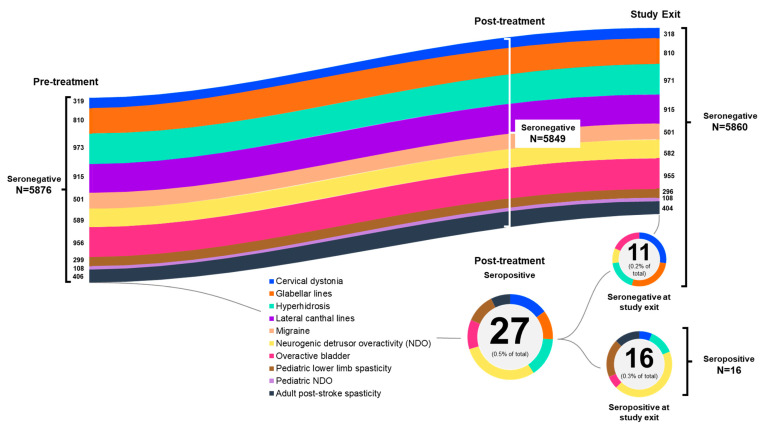
The next question is usually, "So how common is resistance?" When large clinical trials that also included cosmetic Botox for frown lines and crow's feet are pooled, about 1 in 200 people developed resistance. Fewer than 1 in 1,000 found that the Botox effect truly disappeared.
Even people who have a lot of Botox over a long time, such as for neck or limb muscle treatment, developed resistance in only about 2 in 100. Cosmetic Botox in the forehead or between the brows uses far smaller doses, far less often. So there is no need to worry about numbers you have seen online as they are.
Of 916 people who had Botox for crow's feet, not one developed resistance. So when someone tells me the Botox effect was weaker one time, I go over the other reasons before resistance.
Other causes of a weaker effect
People who say their Botox effect has dropped can have many different reasons, and these are the cases I often see in clinic. First, the effect may not have fully come in yet. Botox does not work on the day of the injection; it builds up slowly over 1 to 2 weeks. If you looked in the mirror a few days later and felt the effect was not there yet, look again after 1 to 2 weeks.
Next, the muscle may have grown stronger in the meantime. If you have exercised a lot or frowned more out of habit, the muscle rests less. Then, when you tense your face, a little more movement remains all over. Sometimes the spot or depth was different from last time. Then, if you tense your face in the mirror, you will see just one spot moving, or only an end such as the tail of the brow.
The Botox effect can also be weaker when a smaller dose went in than last time, or when the drug was stored or dissolved differently. I go over these reasons one by one first, and only at the end do I consider true resistance.
Order of checks when the effect drops
When someone comes in saying, "The effect of the Botox I had recently isn't what it used to be," I do not raise the dose on the spot. First I ask when, where and how much you had last time, and whether the effect showed fully then. If you had it elsewhere, it is fine to tell me just as much as you remember.
True resistance looks somewhat different. Even though it was injected in the same spot at the same dose with enough time in between, there is almost no effect several times in a row. When you tense your face, there is hardly any difference from before the injection. In that case I look for the cause with resistance included.
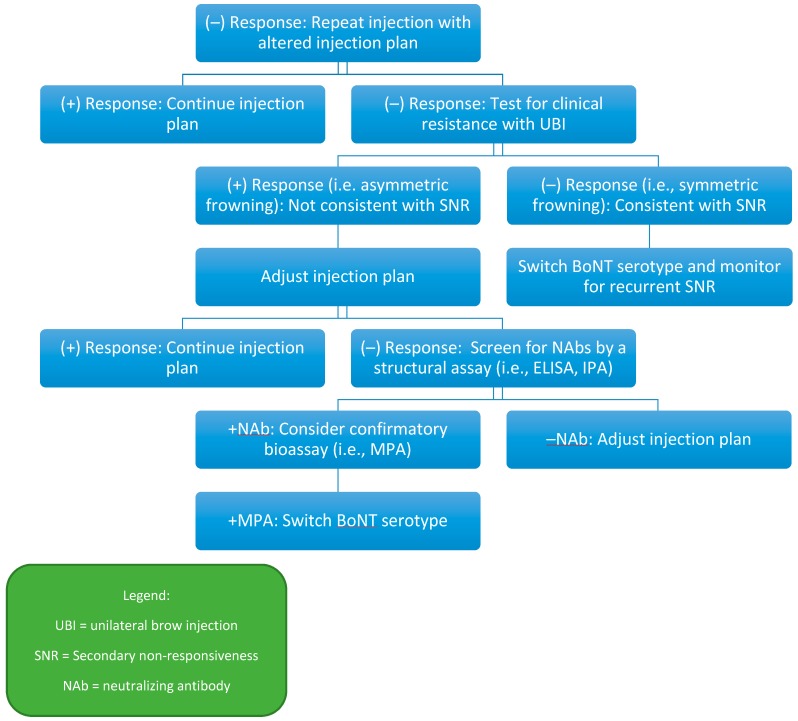
There is also a way to check whether it is resistance. I inject a very small amount in just one spot on the forehead, above the brow, and see whether movement at that spot decreases. If movement weakens only at the injected spot, the Botox is working, so it is not resistance. If left and right stay exactly the same, I suspect resistance. The checking sequence laid out by researchers in the U.S. also goes through this step and ends with a blood test to confirm whether it is resistance.
Botox interval and dose
Some people look in the mirror about two weeks after treatment, say, "This part doesn't seem done yet," and ask me to add a little more. I completely understand the feeling, but in this situation I do not add more right away.
That is because a large amount at once and short intervals are exactly what raise the risk of resistance. There is a study of people who developed resistance while receiving Botox for neck muscle treatment. They had been injected more often and with more. Many had also had additional injections 2 to 3 weeks after the first.
So I set the dose only as high as needed for the effect. Putting in more does not always give a better result. It only adds to the total amount entering the body. The Botox instructions approved by the U.S. FDA also state that the safety and effectiveness of treatment more often than every 3 months have never been confirmed in clinical trials. So I set the next session by watching how long the effect lasts.
What we check before the next treatment
Before setting the next session, I first ask whether the last treatment took full effect and about how many weeks it lasted. I can only decide the dose and interval this time by also looking at Botox given in other areas. So I check the timing and areas of your previous Botox and skin botox too.
The same goes for people who have skin botox regularly. Having it in the skin did not lead to more resistance. Even in underarm sweating treatment, where it is injected into the skin again and again, only about 1 in 200 people developed resistance. So whether it is skin Botox or regular Botox, I use only as much as is needed each time and leave enough time before the next treatment.
To sum up: have Botox at least 3 months apart. Even if the Botox effect seems incomplete, do not rush to have more at 2 to 3 weeks. Just remember when, where and how much you had. If you have it this way, you do not need to worry much about resistance. If the effect feels weaker than before, tell me about the Botox you have had so far before having more.
Botox at Somsei Clinic
At Somsei Clinic, I place Botox differently depending on the concern in the face. These are the types of Botox I inject myself.
- Wrinkle BotoxFor lines that form with expressions, such as on the forehead, between the brows and around the eyes.
- Jaw BotoxReduces a well-developed jaw muscle to slim down the jawline.
- Salivary gland BotoxFor when large parotid or submandibular glands make the side of the face look wide. You can also have it at the same time as jaw Botox or temporalis Botox.
- Skin botoxPlaced in the shallow layer of the skin to tidy up pores, oil and fine lines. If hand injections feel like too much, you can have it as Potenza skin botox.
Jaw Botox and salivary gland Botox usually use a larger amount at one time than wrinkle Botox. So the more regularly you have these, the more attention I pay to the interval before the next one.
Frequently asked questions
QIf the Botox effect is weaker, does that mean I have built up resistance?
Not necessarily. The Botox effect can also be weaker when it has not fully come in yet, the muscle has grown stronger, or the spot and depth were different. When there is almost no effect several times in a row despite the same spot and dose, I include resistance in the search for the cause.
QHow often does Botox resistance happen?
In large clinical trials that also included cosmetic Botox, about 1 in 200 people developed resistance, and fewer than 1 in 1,000 found that the Botox effect truly disappeared.
QCan skin botox cause resistance too?
Having it in the skin did not lead to more resistance. Even in sweating treatment injected into the skin again and again, only about 1 in 200 people developed resistance.
QIf the Botox effect seems weaker, can I have more right away?
Top-up injections 2 to 3 weeks after the first are linked to resistance, so more is not added right away. The first step is to check whether the effect has fully shown.
QHow far apart should Botox treatments be?
The next session is set by watching how long the effect lasts. The Botox instructions approved by the U.S. FDA state that the safety and effectiveness of treatment more often than every 3 months have never been confirmed in clinical trials.
References
- Jankovic J, Carruthers J, Naumann M, et al. Neutralizing Antibody Formation with OnabotulinumtoxinA (BOTOX®) Treatment from Global Registration Studies across Multiple Indications: A Meta-Analysis. Toxins (Basel). 2023;15(5):342. PMID 37235376
- Rahman E, Alhitmi HK, Mosahebi A. Immunogenicity to Botulinum Toxin Type A: A Systematic Review With Meta-Analysis Across Therapeutic Indications. Aesthet Surg J. 2022;42(1):106-120. PMID 33528495
- U.S. Food and Drug Administration. BOTOX Cosmetic (onabotulinumtoxinA) Prescribing Information, revised 10/2024. FDA
- Bellows S, Jankovic J. Immunogenicity Associated with Botulinum Toxin Treatment. Toxins (Basel). 2019;11(9):491. PMID 31454941
- Srinoulprasert Y, Sirisuthivoranunt S, Sripatumtong C, et al. A Pilot Study of Differences in Antibody Responses of Intradermal and Intramuscular Injections of Botulinum Toxin Type A. Dermatol Ther (Heidelb). 2025;15(11):3347-3360. PMID 40911274
- Greene P, Fahn S, Diamond B. Development of resistance to botulinum toxin type A in patients with torticollis. Mov Disord. 1994;9(2):213-217. PMID 8196686
1 min walk from Dunchon-oryun Stn. Exit 1 (Line 9)
Tel 02-488-9119