
Bumps left on the nose: pores or scars?
"The acne settled but the nose is still bumpy." "Is it enlarged pores or a scar?" Bumps left on the nose are often not a pore problem. Most are sebaceous hyperplasia or a hypertrophic scar, or a mix — so extraction and surface care do not clear them.

- PROFESSORAdjunct Professor, Korea University Anam Hospital (current)
- ANATOMYFacial Anatomy Program, Yale University
- ANTI-AGINGAnti-Aging Program, Brigham and Women's Hospital, Harvard
Full profileClose profile
- Adjunct Professor, Korea University Anam Hospital (current)
- Residency, Korea University Anam Hospital
- Facial Anatomy Program, Yale University
- Anti-Aging Program, Brigham and Women's Hospital, Harvard
- Member, Korean Academy of Aesthetic and Laser Surgery
Contents6
Why extraction does not work
The nose behaves differently from other areas. The sebaceous glands are highly developed, inflammation recurs readily, and the skin is thin and three-dimensional, so small changes show.
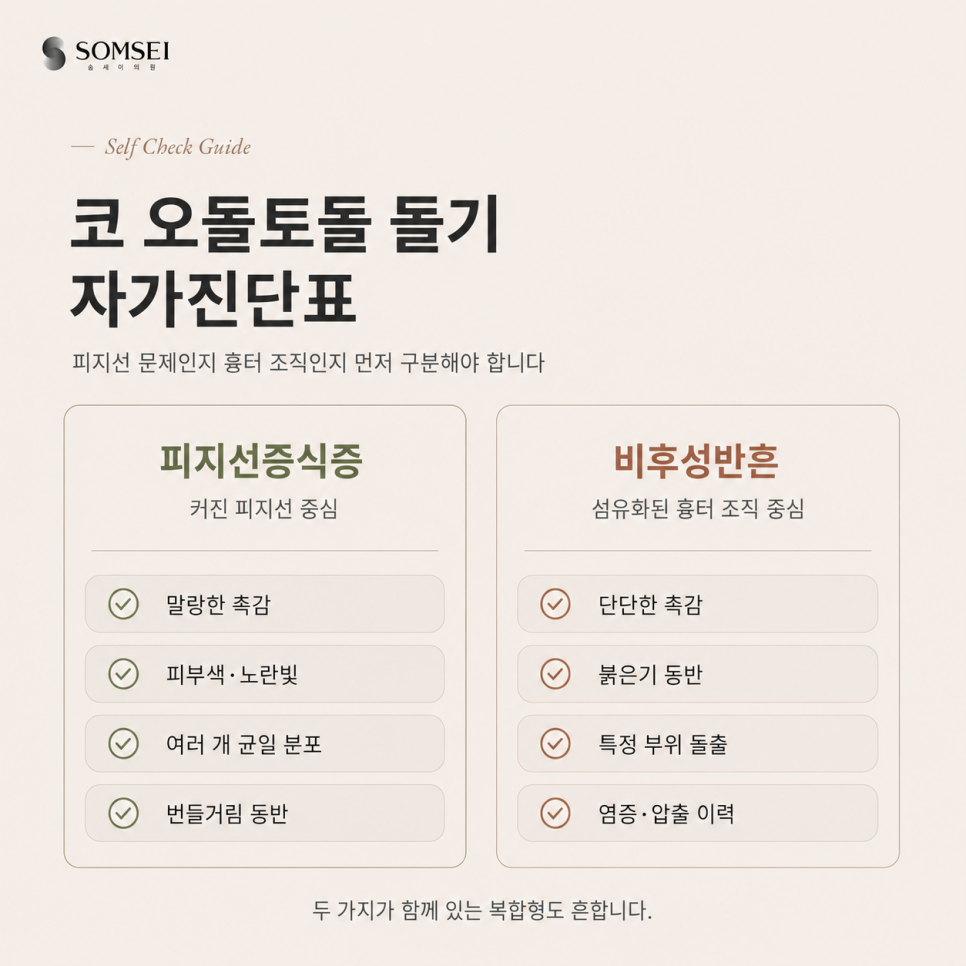
Because of that, skin often does not return smooth after acne settles. The problem is not sebum inside a pore but the enlarged gland itself, or scar tissue already formed. Simple extraction does not improve either and only accumulates irritation.
Pore or scar?
Feeling the area gives a rough sense of which it is closer to. In practice the two are most often mixed, so treat it as a reference. Depth, firmness and inflammatory activity are better confirmed in an examination.
Why the nose needs particular care
Results vary more on the nose than elsewhere, for three reasons.
- The skin is thin and three-dimensional, so even slight depression shows from the front. Intralesional steroid for a hypertrophic scar carries a risk of depression if the volume is high, so the approach is conservative
- Superficial vessels are numerous, so redness can last or vessels show through, making aggressive repetition difficult
- Starting scar treatment while active inflammation remains can enlarge the inflammation or thicken the scar
So accurate differentiation, the order of treatment, and intensity control decide the result.
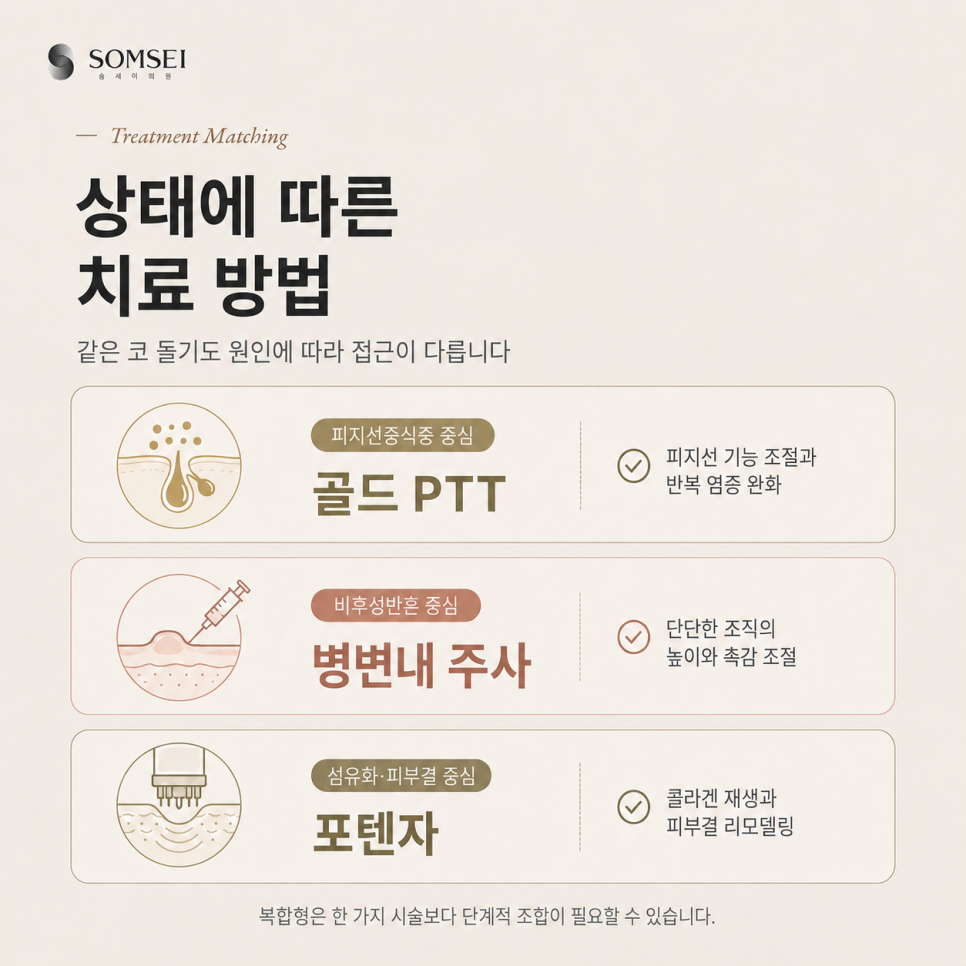
By state
The most common mixed presentation is staged: settle the active inflammation, then regulate the function of the enlarged gland, then finish with the fibrosis and texture.
Not every case needs a procedure. Sometimes waiting is better, and sometimes medication and routine are enough.
Before treatment
- One session is rarely enough. Both sebaceous hyperplasia and hypertrophic scars are treated across sessions
- Results vary widely by area. Skin thickness, gland activity, scarring constitution and inflammatory history all change the outcome. Mention any scarring tendency
- If active acne is recurring, that comes first. Treating marks means little while new inflammation keeps appearing
Frequently asked questions
QWill it go if I extract it?
Sebaceous hyperplasia and hypertrophic scars do not improve with extraction. Repeated irritation can enlarge a hypertrophic scar. Self-extraction is not recommended.
QIs this a keloid?
Most are hypertrophic scars from post-inflammatory fibrosis rather than keloids. If there is a keloid tendency the direction changes, so family history and scars elsewhere are checked.
QWhen do results appear?
Intralesional injection over one to four weeks; collagen-inducing treatment gradually over one to three months. Not suited to a tight schedule.
QIs there downtime?
Intralesional injection is barely visible. Heat or radiofrequency treatments can leave redness immediately after, usually settling within one to three days.
1 min walk from Dunchon-oryun Stn. Exit 1 (Line 9)
Tel 02-488-9119