
Three conditions for Ultherapy without hollow cheeks
The question people ask most before a lifting treatment is whether Ultherapy will hollow their cheeks. The worry is not baseless — people do come in with hollowed cheeks. But look at the cause and it is usually not the device.

Why hollowing happens
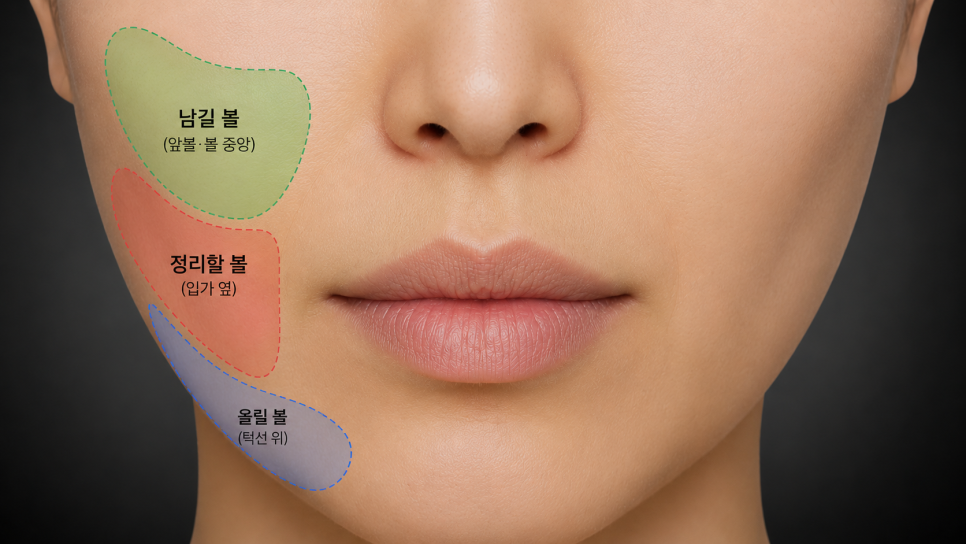
As covered in the first part, cheek fat is not one thing. Volume at the medial and middle cheek carries the face; weight that has descended beside the mouth and above the jawline is what needs reducing. Hollowing comes from that distinction being lost.
While contracting the deep cheek strongly, the anterior cheek volume that was carrying the face empties along with it. It is a question of intensity and placement, not the device. Particular care is needed in these faces:
- A face that did not have much anterior cheek volume to begin with
- A face short of volume at the middle cheek
- A generally thin face
Treating the deep cheek strongly in a face like that does not make it smaller. It leaves it looking flat and tired.
Volume to preserve: the medial and middle cheek. The plane running from under the eye to the front of the cheekbone, and the rounded volume just below the cheekbone. This is what keeps a face bright, and it has to survive the lifting.
Volume to reduce: beside the mouth and above the jawline. Volume that has descended past the nasolabial fold, and volume caught above the jawline. Reducing the weight here is the aim.
Volume to lift: what has descended. Volume that belonged higher and has travelled down with gravity. The answer is not to reduce it but to bring it back to where it belongs.
Which is why order and vector matter
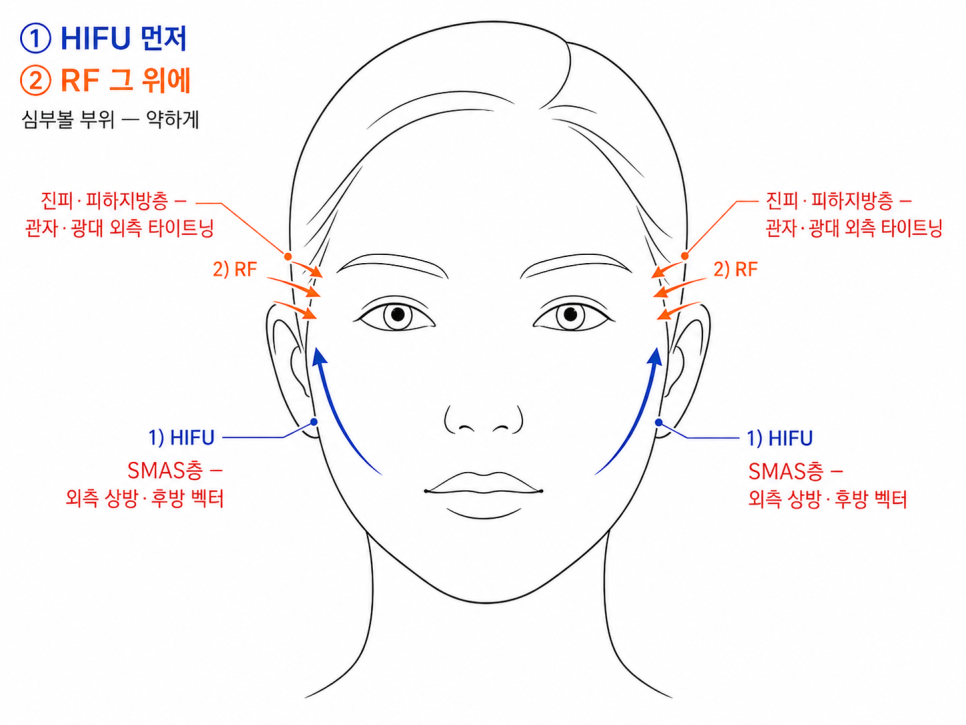
When both treatments are done there is an order. HIFU first, on the SMAS, to draw the underlying frame upward: not simply contracting the SMAS but designing an upward and backward vector centred on the lateral face. Then RF over the top, focused on the temple and outer cheekbone, settling the skin onto the structure HIFU has lifted while reinforcing around the retaining ligaments.
And the caution: the deep cheek(the medial and middle cheek)is not treated at high intensity. Pushing it there can empty the volume that carries the face. Most people who arrive saying their cheeks have hollowed had exactly this happen.
What matters most in lifting
With the same device, the result changes completely with where, at what intensity and in which direction it is applied. That is why the clinical judgement of which layer to target and which vector to design matters.
So the question is not only how much to reduce. It is what to preserve, what to reduce, and what to hold up: three questions at once.
A good cheek is not a small cheek. It is a cheek that has stayed in a good position. And a good lift is not a face pulled tight; it is a face where what should have been kept is still there and only the descended weight has been eased away.
That closes this three-part series. If you have read from the first part, the hope is that a cheek consultation now looks different: not how much cheek fat there is, but where it sits, which layer it is in, and which direction it is moving.
1 min walk from Dunchon-oryun Stn. Exit 1 (Line 9)
Tel 02-488-9119