
Why Juvelook goes in through the Potenza pumping tip, not the N tip
The Potenza pumping tip (CP tip) delivers radiofrequency while injecting a product such as Juvelook straight into the dermis. The N tip and the I tip differ in where they make heat, and neither can inject anything. Juvelook (poly-D,L-lactic acid, PDLLA) has large particles, so the N-25 tip is a little weak for it and it usually goes in with the CP-25. The pumping tip's main job is delivery, though, so if pores or firmness matter too, another tip is used alongside it.

- PROFESSORAdjunct Professor, Korea University Anam Hospital (current)
- ANATOMYFacial Anatomy Program, Yale University
- ANTI-AGINGAnti-Aging Program, Brigham and Women's Hospital, Harvard
Full profileClose profile
- Adjunct Professor, Korea University Anam Hospital (current)
- Residency, Korea University Anam Hospital
- Facial Anatomy Program, Yale University
- Anti-Aging Program, Brigham and Women's Hospital, Harvard
- Member, Korean Academy of Aesthetic and Laser Surgery
Contents7
- 01What the Potenza pumping tip and the N tip each do
- 02Why Juvelook is hard to deliver with the N-25 tip
- 03How the pumping tip differs from hand injection
- 04Why the pumping tip alone is unlikely to fix pores and firmness
- 05When Olidia comes before Juvelook
- 06When Juvelook results show and how many sessions
- 07Frequently asked questions
Reading up on Potenza, you often hear that "the pumping tip is the one you do with skin boosters". After that it is easy to wonder whether you can simply book that combination and be done.
Someone once asked me, after their Potenza session, which tip had been used that day and whether Juvelook had gone in too. The tip that day was the N-25. I told them Juvelook usually goes in with the pumping tip and the N-25 is a little weak for it. The N tip and the pumping tip only sound alike; they are entirely different tips.
What the Potenza pumping tip and the N tip each do
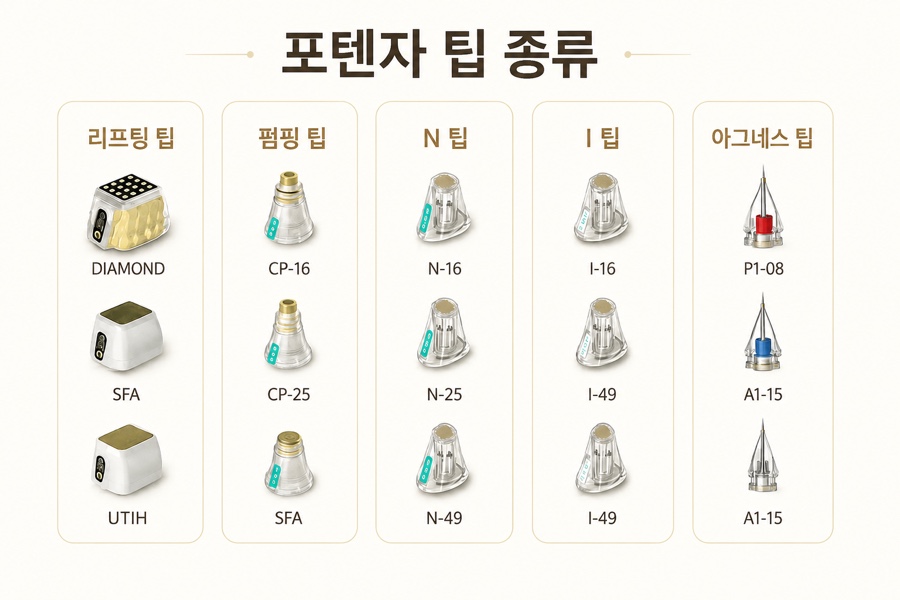
Looking at the tips alone, all three are small cups with several needles, and it is hard to tell them apart from the outside. What differs is what happens in the needles.
On the N tip the whole needle is the electrode, so radiofrequency heat spreads widely and evenly along the needle. It is used for pores, texture and firmness. On the I tip only the needle end is the electrode, so heat gathers at one point at the end; it is used for acne and scars.
The pumping tip (CP tip) injects a product directly into the dermis while it delivers radiofrequency. It is used to put skin boosters such as Juvelook or Rejuran (PDRN) in with Potenza. The first two tips differ in where they make heat; the pumping tip decides where the product is placed.
| Tip | What it does | Mainly used for |
|---|---|---|
| N tip (non-insulated) | Makes heat widely along the whole needle | Pores · texture · firmness · melasma · redness |
| I tip (insulated) | Gathers heat at the needle end | Acne · acne scars |
| Pumping tip (CP tip) | Injects a product into the dermis with RF | Skin boosters such as Juvelook or Rejuran |
Why Juvelook is hard to deliver with the N-25 tip
Like the person above, some people assume Juvelook went in during their N tip session. Juvelook has large particles and needs to go in with the pumping tip. The N tip is a heat-making tip, so it cannot push a product in, and the N-25 is weak for Juvelook.
One experiment looked at how much of a particle product gets in when it is applied on top of small channels made in the skin. A Massachusetts General Hospital team made channels in human abdominal skin with lasers and with microneedle radiofrequency, then applied PLLA particles (Dermatol Surg 2025, PMID 40172072). Particles were seen in up to 80% of the laser channels but in only 1.4% of the microneedle radiofrequency channels.
This was done on skin removed from the body, and it used PLLA particles from the same lactic acid family rather than Juvelook. Even so, the finding that little gets in when particles are applied over needle channels points the same way as the reason Juvelook goes in with the pumping tip.
How the pumping tip differs from hand injection
The pumping tip is not the only way to put Juvelook in; it can also be injected by hand. With hand injection the product tends to clump in one spot wherever the needle went in.
With the pumping tip the product comes out at the tip of the needle carrying the radiofrequency and is placed straight into the dermis. It hurts less than ordinary hand injection, and the product goes into the skin more evenly and densely.
Why the pumping tip alone is unlikely to fix pores and firmness
After hearing that skin boosters and the pumping tip go well together, it is easy to expect the pumping tip alone to improve pores and firmness as well. The pumping tip's main job is delivering the product. If you want the tightening effect of radiofrequency itself, you need the N tip or the I tip as well.
When pores and scars are both present, the tips are split by area. Areas with stretched pores get the N tip and areas where scars cluster get the I tip. The whole face is not treated on one setting.
| What you want now | Tip used |
|---|---|
| Juvelook to refine skin texture | Pumping tip CP-25 |
| Juvelook plus pores and firmness | Pumping tip + N tip |
| Some areas have depressed acne scars | I tip on those areas |
When Olidia comes before Juvelook
In consultations I am often asked, "Which product do you use?" I do not answer with a product name straight away; I first ask which area you want to change and by how much. Whether you plan to repeat it and how much a nodule would worry you are part of it too.
If the front or side of the cheek has hollowed and more volume is needed, the PLLA-based Olidia often does better than putting Juvelook in with the pumping tip. Juvelook is PDLLA-based and tends to suit people aiming for a natural texture improvement or worried about nodules. Its nodule risk is relatively lower, but it is not zero.
When Juvelook results show and how many sessions
A few days after Juvelook you may look in the mirror and feel nothing has changed. It works by getting your own skin to make collagen slowly where it was placed, so change mostly appears over 1 to 3 months. It does not suit a tight deadline.
It depends on how much change you want, but satisfaction tends to be high after about three sessions. Unlike hyaluronic acid filler there is no way to dissolve it, so the initial plan matters more.
A Korean case series gave Juvelook with microneedling to 15 people with enlarged pores, three times at 3-week intervals (Plast Reconstr Surg Glob Open 2025, PMID 40469551). The average pore score went from 6 to 3 at 12 weeks and held to 22 weeks. Some had redness and swelling, which settled within 48 hours. It was a case series of 15 people without a control group, and the product went in with ordinary microneedling, not a Potenza pumping tip.
This study also treated three sessions as one course and measured the effect at 12 weeks. Expecting a change right after one session can lead to disappointment. If you are travelling for treatment, plan around three sessions and a result that builds over 1 to 3 months, not a single visit.
Frequently asked questions
QHow is the Potenza pumping tip different from the regular tips?
The pumping tip (CP tip) injects a product into the dermis while delivering radiofrequency. The N tip and the I tip make heat and cannot inject anything.
QCan Juvelook go in with the N tip?
Juvelook has large particles, so the N-25 tip is weak for it. It usually goes in with the CP-25 pumping tip.
QWill the pumping tip alone improve my pores?
The pumping tip's main job is delivering the product. If you want pores or firmness addressed too, having the N tip as well is the better plan.
QDoes the pumping tip hurt less than hand injection?
It tends to hurt less than ordinary hand injection, and the product goes into the skin more evenly and densely.
QWhen do Juvelook results show?
Mostly gradually over 1 to 3 months. Satisfaction tends to be high after about three sessions.
QMy cheeks have hollowed. Can Juvelook with the pumping tip fill them?
If the front or side of the cheek has hollowed and needs more volume, the PLLA-based Olidia often does better. Juvelook tends to suit texture improvement.
1 min walk from Dunchon-oryun Stn. Exit 1 (Line 9)
Tel 02-488-9119