
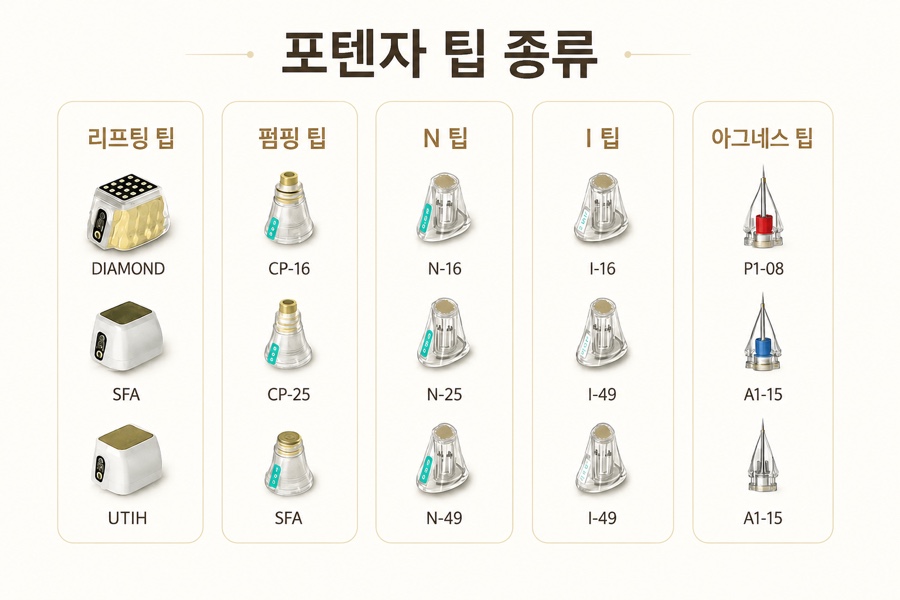
RF microneedling tips: what is the difference?
You will have heard that one tip is for pores and another for acne scars. But if you have both, which do you have? Before memorising tip names, know that every effect starts from the heat the current makes. What differs is where that heat is made.

A non-insulated tip heats broadly
Energy comes from the whole needle, so current does not concentrate at one point but spreads across a wide area. Current density is lower and the heated range wider. Three things follow from that gentle heating:
- Existing collagen contracts immediately under heat
- The stimulated tissue produces new collagen as it recovers
- Vessels stabilise and chronic inflammatory response decreases
It is like warming a whole room evenly with an electric blanket: not searing one spot, but warming a broad area moderately so the tissue repairs itself.
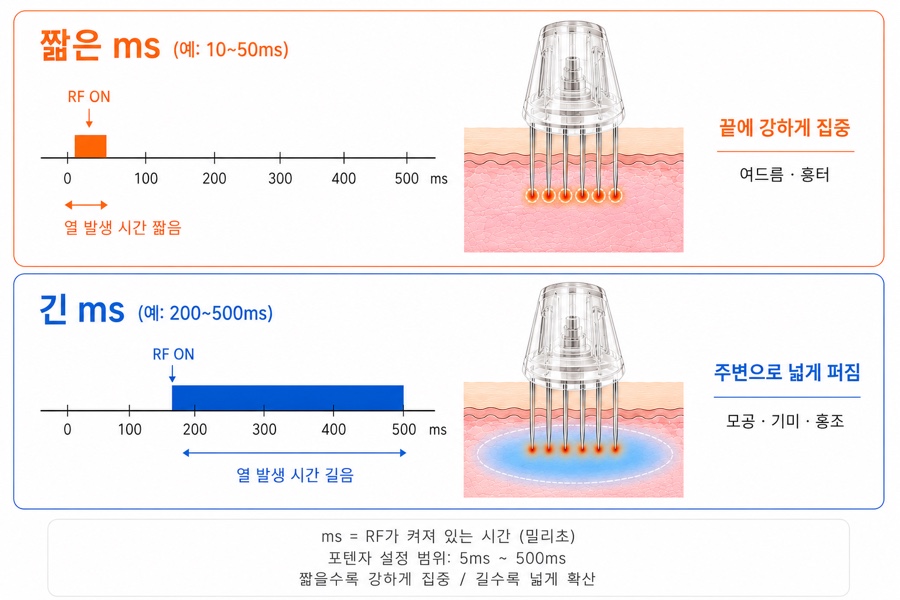
Push the energy too high or set the pulse width too short and heat spreads excessively into surrounding tissue, becoming irritation instead. With melasma or flushing present, a low and gentle setting is the rule.
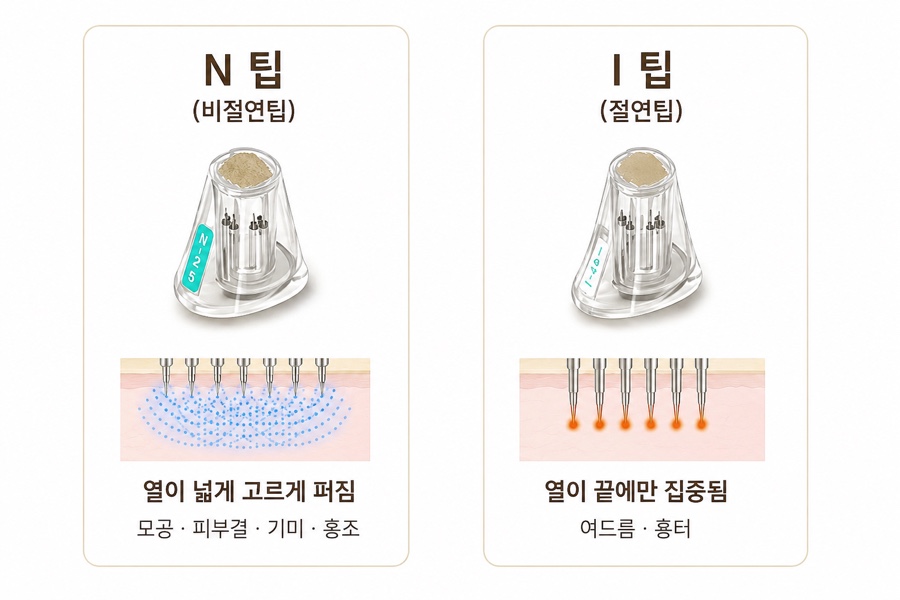
An insulated tip concentrates at a point
The same energy behaves differently. Only the needle tip is exposed as an electrode, so current concentrates there and current density rises sharply, producing a strong zone of thermal coagulation around the tip.
- For acne, strong coagulation at the depth of the sebaceous gland suppresses its function
- For acne scars, it reaches the depth of the scar tissue and creates fine thermal injury that restarts the wound healing process. New collagen forms and the depression gradually rises
Closer to searing a specific spot precisely. Treating acne with a non-insulated tip does little, because the current density is too low to produce sufficient coagulation at the gland.
Scars do not finish in one session. Usually several, about four weeks apart, with the approach varying by depth and type.
Pulse width matters as much as the tip
Even with the right tip, the pulse width setting has to match. It is how long the radiofrequency lasts. Use a non-insulated tip with a short pulse width and the result differs from what was intended. Tip and setting have to work as a set.
By concern
With pores and scars both present, the areas are treated differently: non-insulated where pores dominate, insulated where scars do. Treating the whole face at one setting does not fit.
Frequently asked questions
Can two tips be used in one session?
They can be used by area. Where pores dominate and where scars dominate need different approaches, sometimes on the same day.
What is a pumping tip for?
Its main purpose is delivering a substance. If you want the tightening effect of radiofrequency itself, a non-insulated or insulated tip is needed alongside.
How many sessions for scars?
Not one. Usually several about four weeks apart, varying with the depth and type of scar.
Is stronger better?
No. In pore treatment, pushing the energy too high or the pulse width too short only increases irritation and inflammation. Whether tip and setting suit the purpose matters more than intensity.
1 min walk from Dunchon-oryun Stn. Exit 1 (Line 9)
Tel 02-488-9119