
Why several treatments at once is not a bargain
Skin concerns rarely arrive one at a time. The jawline blurs while the texture is rough, and pores and acne scars bother you while the skin flushes easily. What you have matters, and so does how far apart.


Skin changes while it recovers
Skin does not improve on the day of a laser or RF treatment. After the stimulus it needs time to recover on its own, producing collagen and reorganising tissue.
What matters in that process is not only the strength of the stimulus. Whether it reached the right depth, and whether recovery was complete before the next session, matter too. Adding another strong treatment while the skin is still sensitised leaves redness and dryness for longer.
The sequence the skin has to follow is stimulus → regeneration → settling → recovery. Break that and the next change does not follow smoothly.
Different treatments do different jobs
Stacking is a poor bargain because each treatment has a different role. They are not the same stimulus repeated; they work in different layers doing different things.

Scars are not only a surface problem
An acne scar is not just roughened surface. Where inflammation ran deep, fibrous tissue forms beneath and pulls the surface down.
While that tethering remains, stimulating regeneration will not lift the depression fully. A treatment that induces dermal regeneration and one that releases what is under the scar do different jobs, and depending on the skin they need to be applied together to balance.
Why spacing matters
Recovery starts immediately after treatment. Redness and swelling take days to settle, and the process of building new collagen and reorganising tissue runs far longer.
Stacking a lot of stimulus at once feels like having had a strong treatment. But if the skin has no room to recover, dryness and sensitivity linger. Leaving space so regeneration and settling follow naturally gives a better result.
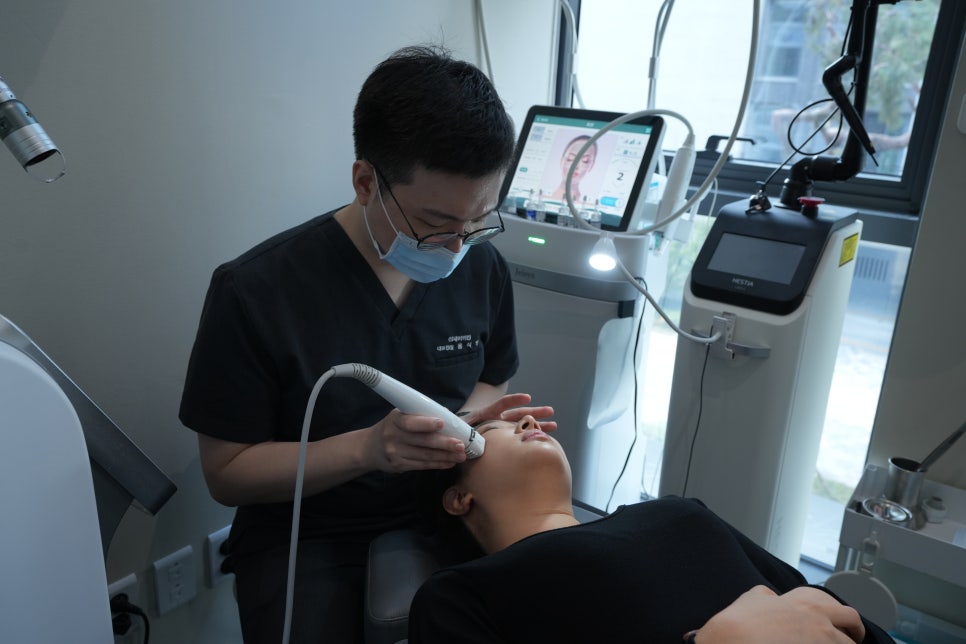
When treatment is staged
- Jawline and firmness, pores and texture all bother you at once
- There are acne scars but strong scar treatment feels like too much
- Redness and dryness tend to last after treatment
- You would rather manage in order than solve everything at once
Conversely, where inflammatory acne is currently active or the barrier is markedly sensitised, the inflammation and the barrier need stabilising before any order is set.
Frequently asked questions
Can two treatments never be done on the same day?
Not never. Where the roles and the layers differ, they can be. The problem is stacking strong stimulus in the same layer.
How long between sessions?
It depends on the treatment and how fast the skin recovers. If redness and dryness remain, postponing the next is better.
Is stronger better?
No. Whether the stimulus reached the right depth matters more than its strength. An intensity recovery cannot keep up with does not translate into a result.
What comes first?
Whether inflammation is active. If it is, that comes first. If not, the order depends on whether the structural problem or the surface problem bothers you more.
1 min walk from Dunchon-oryun Stn. Exit 1 (Line 9)
Tel 02-488-9119