Why Korean clinic procedure names do not match the English ones
Most Korean procedure names are product names, while most English ones are names for a method. That is why the two lists never line up one to one. Ultherapy and Shurink both come out as HIFU in English, and mulgwang jusa is translated as skin booster and as microinjection. Before I try to match the names in consultation, I work out which layer the treatment puts something into and what that something is. Even when the names match, a different depth and a different volume give a different result.
Last month a patient flew in from Taipei with nothing but "skin booster" written in her booking note. When I asked her in person, what she wanted was Rejuran, and what she had received at home the year before was mulgwang jusa. Three names came up in one sitting and all three were different treatments.
This mismatch comes up constantly with patients who travel here. They repeat the name they found while searching, the clinic uses a different word, and once it passes through an interpreter it becomes a third word. Half the consultation can go on matching names.
The cause is that the two languages named these things in different ways. What we call a treatment in Korea is usually a product name, while the English term is usually a name for the method. A company decides a product name and the method name is decided by what is being done, so put the two lists side by side and the rows do not meet.
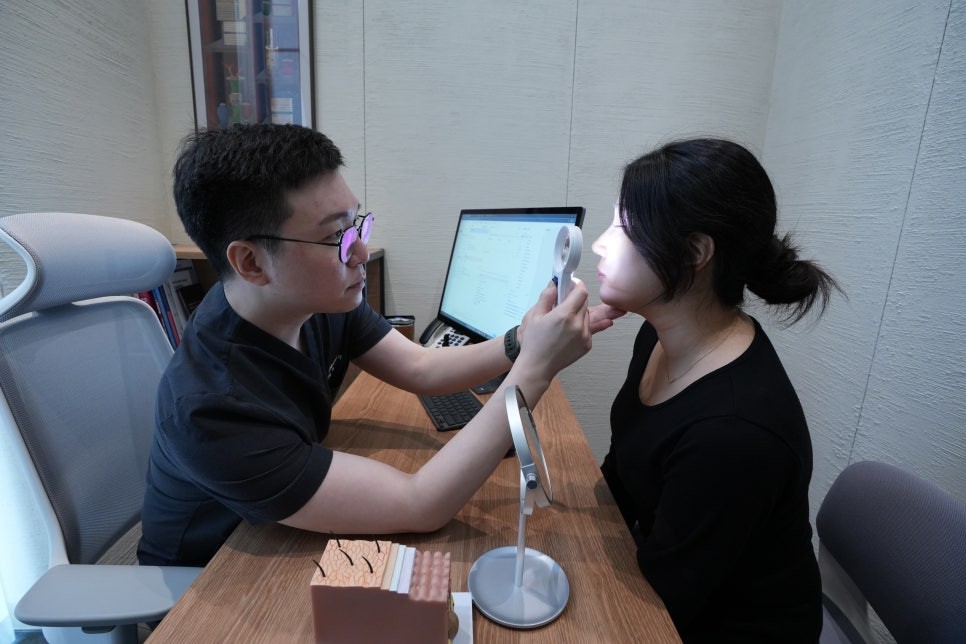
The gap between the name you searched and the name the clinic uses
Almost every consultation opens with a name. Someone saw Ultherapy in a magazine, or a friend had Shurink. Translate both into English and you get the same word. They work the same way, with focused ultrasound, so English speakers file them both under HIFU.
It runs the other way too. When "skin booster" is written on the form, I have to ask again whether it means mulgwang jusa, Rejuran or Juvelook, because that single English term has several Korean products hanging off it.
So I do not take the name on the booking note at face value. I ask first what was bothering you that made you search for that name. Names change; the concern does not.
Why mulgwang jusa is not simply a skin booster
When patients come in asking for mulgwang jusa and I ask what they expect, the answers split. Some want their makeup to stop sitting badly, others want their face to look glossy. The second expectation comes from the name itself, which literally means water glow injection.
Mulgwang jusa places hyaluronic acid into the shallow dermis in many small deposits. English uses skin booster when the emphasis is on the material and the purpose, and microinjection or mesotherapy when the emphasis is on how it goes in. Chinese keeps the name shui guang zhen, written 水光针. All three describe one treatment from a different angle.
The trouble is that skin booster is a wide term that fixes neither the material nor the depth. Rejuran sits under it and so does Juvelook. So when only the English name arrives, we have no choice but to ask again.
Why Ultherapy and Shurink are both called HIFU in English
Patients put the two names in front of me and ask which is better. They are the same method. Ultrasound is focused on a single point under the skin so that only that point gets hot, and as those points heal the tissue tightens. English calls this HIFU; Chinese uses 超声刀, which covers the whole family.
Ultherapy is the name of a device developed in the United States, so it travels as Ultherapy in English too. Shurink is the name of a device widely used inside Korea, so it does not travel. Tell your doctor at home that you had Shurink and you will usually get a blank look.
What separates the two devices is not the name but the size of the focal point, the range of depths you can select, and how many lines are delivered in one session. Within the same family, those three things change the result.
Why InMode and Potenza are both radiofrequency but named differently
I regularly hear that someone had InMode and noticed no difference. When I ask which tip was used, most patients do not know. InMode is a company name with several tips under it: FX works on shallower layers, Forma covers a broad area. What you could expect depended on which one you had.
Potenza uses the same radiofrequency but delivers it differently. Needles enter the skin and the energy comes out only at their tips, so heat goes to the chosen depth without touching the surface. English calls this RF microneedling. So InMode gets written as RF and Potenza as RF microneedling.
In consultation I talk about which layer we are trying to reach before I talk about a device. A patient worried about pores and a patient worried about the jawline walk into the same clinic and need different layers.
How Rejuran and Juvelook are written in English
Patients who come for Rejuran usually say their skin has turned rough. Rejuran places polynucleotides extracted from salmon DNA into the dermis, so English writes the material itself: polynucleotide injection, abbreviated PN or PDRN.
Juvelook belongs to another group. It does not shape anything the moment it goes in; it is a material that makes collagen over time, so English files it as a collagen stimulator or biostimulator. Sculptra and Olidia go in the same box.
Why the distinction matters shows up in recovery. The kind placed in many small deposits in the shallow dermis leaves tiny marks for a day or two, while the kind placed as a bolus under the skin leaves swelling for several days. For a patient on a short itinerary, that difference matters more than the name.
When laser toning does not translate
Patients often tell me they have had toning more than ten times. Ask which laser and they cannot remember. Toning is not a device name; it refers to low energy delivered in repeated passes, so the word alone does not tell me what you received.
English language papers rarely say laser toning. They write the wavelength and the energy, as in low fluence 1064nm Nd:YAG. Pico toning is written as picosecond laser. If you may need to show your record to a doctor at home, that is the form that carries.
Korean and English procedure name table
Reading this once before your consultation makes the conversation faster. The last column is what actually happens; when that column matches, two different names are in the same family.
| Korean name | How to search in English | What it actually does |
|---|---|---|
| 물광주사 mulgwang jusa (水光针) | skin booster · microinjection | Hyaluronic acid placed in the shallow dermis in many small deposits |
| 스킨부스터 skin booster | skin booster | Umbrella term for injectables that work on skin quality |
| 울쎄라 Ulthera (超声刀) | HIFU · Ultherapy | Ultrasound focused to a point in the deep layer to create heat |
| 슈링크 Shurink (超声刀) | HIFU | Same ultrasound family, a device distributed mainly inside Korea |
| 써마지 Thermage (热玛吉) | monopolar RF | Radiofrequency heating the dermis broadly |
| 인모드 InMode | bipolar RF | Heats the narrow zone between two electrodes |
| 포텐자 Potenza (射频微针) | RF microneedling | Needles enter first and radiofrequency comes out only at the tips |
| 리쥬란 Rejuran | polynucleotide injection · PN · PDRN | Material extracted from salmon DNA placed in the dermis |
| 쥬베룩 Juvelook · 올리디아 Olidia | collagen stimulator · biostimulator | Makes collagen build up over time |
| 토닝 toning (激光调理) | low fluence 1064nm laser · laser toning | Low energy delivered in repeated passes |
| 아이피엘 IPL · 포토페이셜 | IPL · photofacial | Broad spectrum light treating pigment and redness together |
Three questions to ask instead of a name
You do not need to memorise any of it. Three questions in consultation sort out most of it. Which layer does this treatment work on. How many sessions to reach the level you described. And why this rather than the alternatives.
If the third question stalls, look at that consultation again. A device is chosen to fit the concern; fixing the device first and bending the concern to fit it reverses the order. When I am asked, I say what I saw in your skin today that pointed me that way. If I cannot put the reason into words, I do not choose that treatment either.
Where the same name becomes a different treatment
Two patients who both had Ultherapy did not have the same thing. It depends on whether 100 or 300 lines were delivered, how the depths were mixed and in what ratio, and whether it stopped at the jawline or continued down the neck. The name on the receipt is the same and the contents are not.
Injections are no different. One session of mulgwang jusa with 1cc is not the same as one with 2.5cc, and the same volume spread over the whole face is not the same as the same volume concentrated in the cheeks. So when patients bring quotes to compare, I tell them to get the numbers next to the names: shot count, volume and area.
What happens when you book on the name alone
Sometimes a patient arrives with a name decided and the examination points somewhere else. Not long ago someone came in booked for Ultherapy, and after seeing her I never raised lifting at all. Her skin had thinned and dried until the shadows read as deep, and a heat based treatment was not going to solve what she came in for that day.
On days like that I do not simply deliver the booked treatment. When the name fits but the condition does not, you spend the money and feel nothing. That holds even when someone has one day only and wants something done today. I tell them that not treating today is not a loss.
Some consultations are about lowering expectations. Few treatments change a face the way a photograph does, in one go. Lifting comes up gradually over two or three months, and a collagen stimulating injection takes about six weeks before photos can be compared. Judge by the mirror on the last day of your trip and you will usually be disappointed.
Why I write your treatment record in English
If something happens to your skin after you fly home, you will see a doctor there. Carrying only Korean product names, the explanation does not land. I have had several calls from doctors abroad asking what exactly was injected.
So for patients visiting from other countries I write out, in English, the material class, the volume or shot count, the area and the date once the treatment is finished. If filler went in, I add which layer and how much. That one sheet of paper is what stops a second product being layered on top of the first in another country.
Frequently asked questions
Do I have to decide on a procedure name before booking?
No. Tell us where the concern is and how long it has been there, how many days you are in Korea, and any treatments you have had before, and we decide after the examination. Coming in with a name already fixed tends to steer the conversation toward that name.
Which is better, Shurink or Ultherapy?
They are in the same ultrasound family, so better and worse is not the right split. The focal size, the depths available and the number of lines used differ, and which suits you depends on your skin thickness and how much laxity there is.
What is the difference between mulgwang jusa and Rejuran?
The material. Mulgwang jusa is hyaluronic acid, which holds water. Rejuran is polynucleotide, which prompts the tissue to respond. English lumps both under skin booster, but what to expect and the interval between sessions are different.
Will a doctor at home understand the English names?
Names written as method and material carry better than product names. Write HIFU instead of Shurink, wavelength and energy instead of toning, polynucleotide instead of Rejuran, and the explanation works.
What should I ask for when comparing quotes?
Get numbers next to the names. Shot count for energy treatments, volume for injectables, and which areas are included. A quote missing those three cannot be compared with another one.
1 min walk from Dunchon-oryun Stn. Exit 1 (Line 9)
Tel 02-488-9119