
Filler in the neck lines and they are still there. Why?
"I had filler in my neck and the line is still visible." "It stays there even when I hold my head up." Neck lines are not like fine lines around the eyes. When the same crease repeats for long enough, the tissue beneath binds down, and filling alone is not enough.

Neck skin is thinner than facial skin and has fewer sebaceous glands, so dryness and loss of firmness appear relatively early. Add the habit of looking down, sleeping position and repeated movement, and the same place folds over and over.
At first the line shows only when the head is lowered. Over time it stays when the head is up. An old neck line is less a surface crease than a state in which the tissue beneath has fibrosed and bound down through repeated folding: something like a cord under the skin holding the line in. Closer to a scar than to a wrinkle.
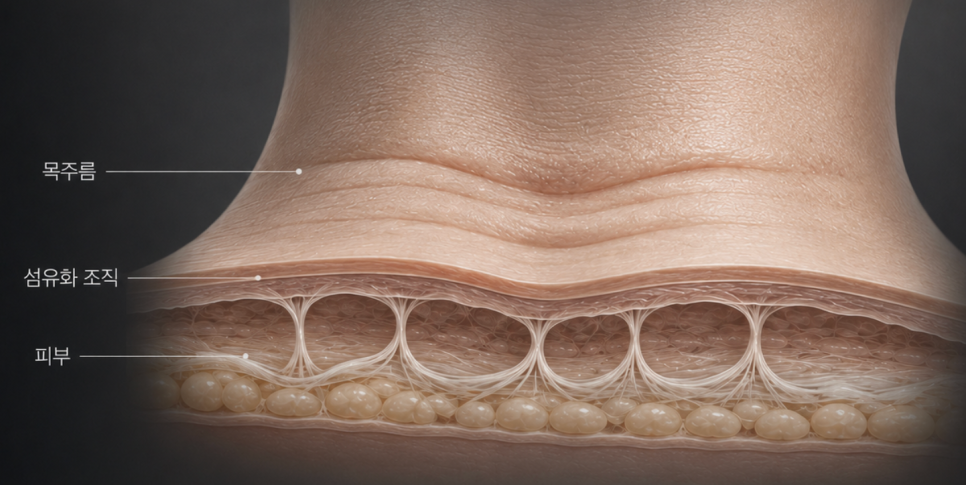
Why the line remains after filler
Filler is effective at filling a lost space. It is a different matter when the tissue beneath is firmly tethered.
With the tethering still there, the fibrotic tissue pulling down and the filler pushing up work against each other. It may look slightly softened right after, but the line does not smooth out, or becomes visible again with time.
Adding more filler is not the answer either. The neck has thin skin and a lot of movement, so overfilling looks lumpy or unnatural when the head turns. Creating the conditions for the filler to settle naturally comes before adding volume.
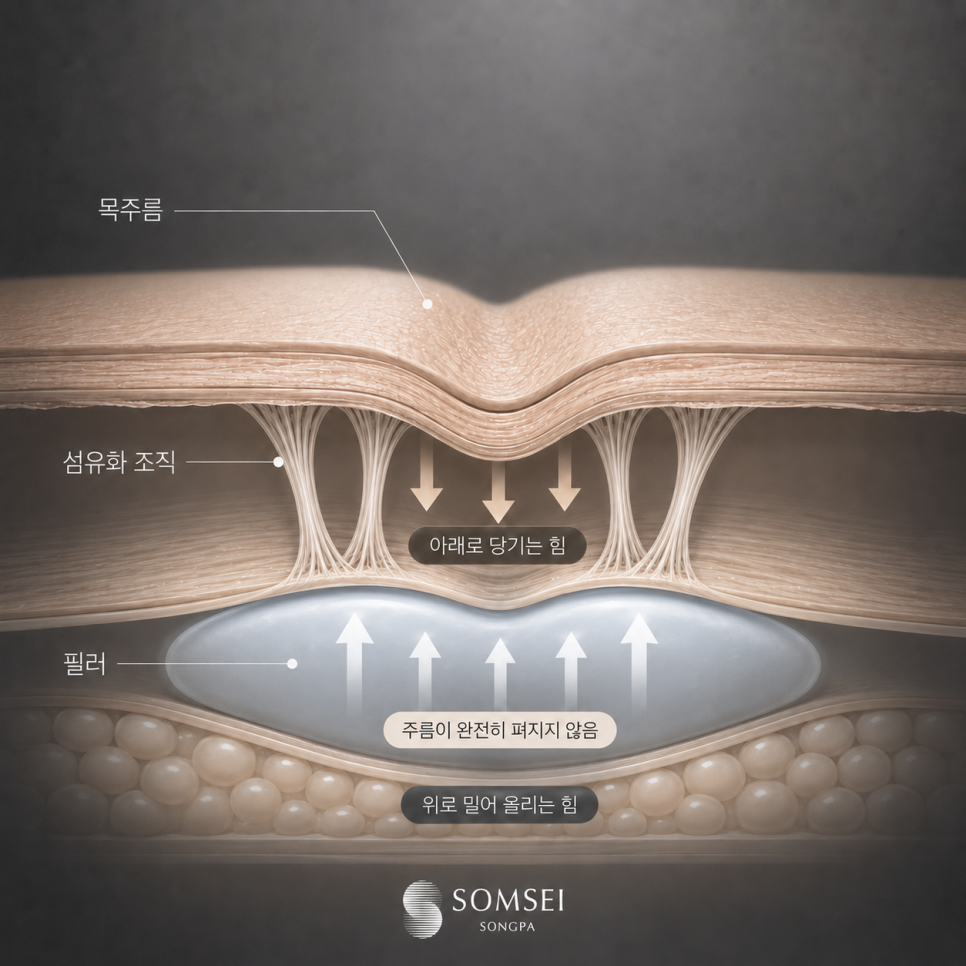
Releasing and filling are different jobs
Fill without releasing the tethering and the line stays. Release without filling and the depression stays. The two have to happen in order.
Depth, direction and skin thickness differ between people. Rather than treating the whole neck at one depth, only the lines that are genuinely tethered are released, along their actual course. Hyaluronic acid is then added only as much as the created space needs.
How much improvement to expect
This is not a treatment that erases an established neck line like a pencil mark. It releases the tethering and supports the depression so a deep, sharp line reads as softer.
Where the line has been deep for a long time or the fibrosis is strong, it is better staged across sessions than pushed in one. Judge by how the line settles after swelling subsides, not by the volume immediately after.
Frequently asked questions
Can filler alone work?
For an early neck line with no tethering beneath, yes. Once the line stays when the head is up, whether something is pulling from below needs checking first.
Will the line disappear completely?
It is not a treatment that erases. It softens a deep, sharp line, and where fibrosis is strong it is staged across sessions.
When can I judge the result?
After the swelling subsides. The volume immediately after is not the result.
Do bruises show?
The neck has thin skin and many vessels, so bruising is common and can last. Leave room before an important date.
1 min walk from Dunchon-oryun Stn. Exit 1 (Line 9)
Tel 02-488-9119