
A lump you can feel after Olidia: is it a nodule?
Feeling something after Olidia does not mean it is a nodule. For the first few days it is normal to feel the injected fluid and the swelling, and that goes away with time. A nodule usually shows up weeks later, keeps its shape when pressed, and stays in one place. If it is small, painless and invisible from the outside, we often just watch it. If it grows, turns red or hurts, do not wait.

About two or three weeks after Olidia, patients come in saying "there is something I can feel here." In most cases nothing shows in the mirror and they only know it by touching it with their fingers. But once you start feeling it, you keep feeling it, and the more you touch it the bigger it seems.
The first thing I do in that consultation is not a diagnosis but sorting it out. There are several kinds of palpable thing, and each kind is handled differently.
The opposite happens too. Some patients come in worried that they cannot feel anything at all. "It has been two months and it still does not look like much." Then we put the photos side by side and often the difference is there. With a collagen stimulator, looking in the mirror every day tells you little. You have to compare photographs.
Telling them apart by when you first feel it
Olidia is a collagen stimulator made of PLLA (poly-L-lactic acid). It is approved by Korea's MFDS as a tissue restoration material, and the approved purpose is the temporary correction of nasolabial folds. Unlike a hyaluronic acid filler, which takes shape the moment it goes in, it works by prompting your skin to build its own collagen, so the change appears over four to six weeks.
That is why the timing of when you first feel something is such a useful clue.
| When | What you are feeling | What usually happens |
|---|---|---|
| Day of treatment to day 3 | Injected fluid and swelling | Goes away as it settles |
| Around week 1 | A bruise or a pressed mark | Goes away as the colour fades |
| Week 3 to month 2 | A firm grain fixed in one spot | I consider a nodule |
What you feel right after the treatment is mostly the fluid that went in. Many patients mistake this for a nodule and become anxious, but at that point there has not been enough time for a nodule to form. Conversely, if something new becomes palpable at around a month when it was not there before, that needs checking.
Why nodules form
When I listen to patients who come in with a palpable nodule, the circumstances of the treatment day differ a little each time. With PLLA products, the dilution before the treatment and the way it is injected have a lot to do with the result. It has been reported that particles can gather in one place and form a clump if the dilution was insufficient, if the product was delivered into one spot, or if the post-treatment massage was skipped.
So when I work with Olidia I treat dilution, dispersion and massage as three stages of one treatment. It is not a treatment that ends when the syringe comes out. If one stage is missing, nothing happens on the day and it surfaces weeks later.
Thin skin matters as well. With the same amount injected, thin areas like under the eyes or the temples become palpable with only slight clumping, while a thick area like the cheek can hold the same clumping without anyone noticing.
Three things mistaken for nodules
Sometimes there is a long ridge you can feel along the injection track. That is tissue reacting along the path the needle took. Unlike a lump it is line-shaped, and it usually disappears faster.
A deep bruise also feels firm. If the colour is turning yellow as it fades, it is the bruise. Bruises change colour and nodules do not, which is the easiest way to tell them apart.
Many patients also say the two sides feel different. A face is never symmetrical to begin with, and cheek thickness and fat volume differ side to side. With the same amount injected, the thinner side becomes palpable first. If this is mistaken for asymmetry and more product goes into the other side, matching them up gets difficult from then on.
When to watch and when to come in
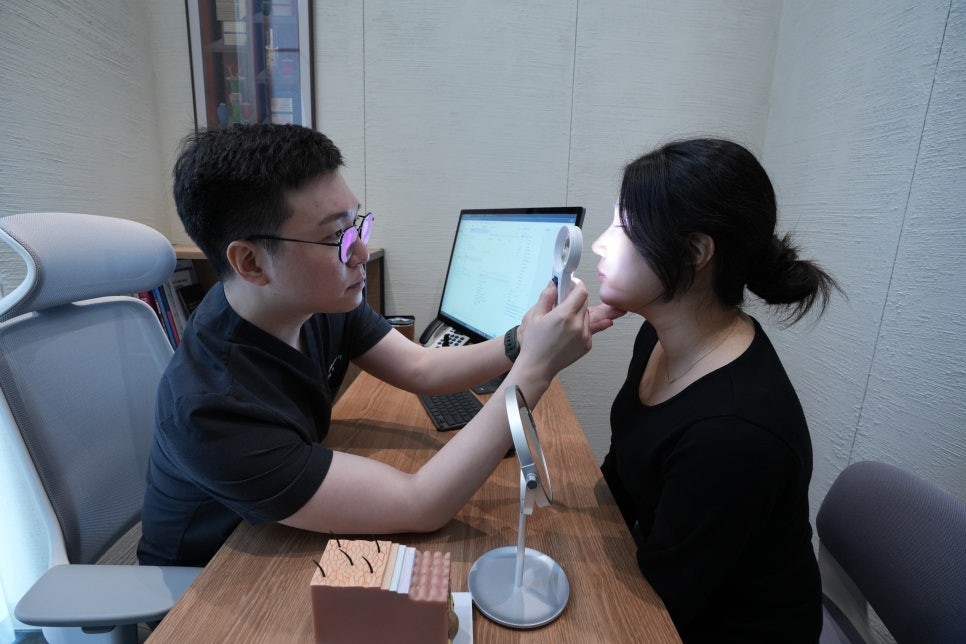
Even when what I feel looks like a nodule, more often than not I do not treat it that day. Here is what I go by.
| Watch and wait | Needs to be seen | |
|---|---|---|
| Size | Smaller than a grain of rice | Growing steadily |
| Pain | No pain when pressed | Hurts when pressed, or hurts at rest |
| Appearance | Not visible in the mirror | The skin bulges or turns red |
| Change | Shrinks over two to three months | Unchanged or larger after a month |
If you are in the left column, time usually sorts it out. What I do ask is that you stop touching it. Repeated irritation makes the surrounding tissue react as well, and it lasts longer that way.
If even one item in the right column applies, do not wait. Redness or heat in particular can mean something other than a nodule, and that has to be checked in person. What is done about it depends on the condition, so I will not lay out one method here. If you have already flown home, send me photographs taken a few days apart and I will tell you whether it needs to be seen where you are.
What I check before recommending Olidia
Even when collagen stimulators come up in a consultation, I do not book a date on the spot. There are a few things I ask first. If there is an autoimmune condition, a tendency to keloids, or a recent infection, I rethink the material. I also check whether another filler is already sitting in the same area. When layers overlap, it becomes hard to tell later which one is responsible for what you feel.
If you have an important date coming up, I tell you to push the treatment back. A collagen stimulator delivers its result over four to six weeks, so it is not a treatment you time to a date. Rushing it before a wedding or a shoot is what patients regret most. The same goes for a short trip: if you are flying home in a week, you will be leaving before the result is visible, so plan to see it at home.
Three points where I look at the progress
Once the syringe comes out it can look as though the day's work is done, but with Olidia several weeks are still ahead. I look at the progress at three points. Through the first two weeks, whether bruising and swelling are within the normal range. At four to six weeks, whether the change is coming up. After that, whether both sides settle in similarly.
The timing of a second session comes out of these checks too. If the first session was slow to respond and I shorten the interval, everything comes up late and overlapping. Slow to respond and not enough are different things. Increasing the amount without telling those two apart is the most common road to a nodule.
When I do not recommend Olidia
Listening to what a patient wants, there are cases where a collagen stimulator is not the answer. That is when the goal is to see a filled-out face right now. Hyaluronic acid suits that goal, and the result is there on the day.
I also take another look when sagging is the main cause and someone wants to solve it with volume. There is a limit to how much filling can lift, and as the amount grows the face can start to look heavier.
For patients who have had a nodule from the same class of product before, I change the material and the injection layer, or recommend a different approach altogether. Skin that reacted that way once may well do so again under the same conditions.
I can feel something right after the treatment. Is it a nodule?
At that point there has not been enough time for a nodule to form. In most cases you are feeling the injected fluid and the swelling, and it settles within a few days. If something firm is still there in the same spot after three weeks, that is when I check it.
Do nodules go away on their own?
Small painless ones often shrink over two to three months. But if it is growing, painful or visible, waiting is not the answer.
If I skip the massage, will I really get a nodule?
Massage alone does not decide it, but even with adequate dilution and dispersion, skipping the massage leaves room for particles to gather in one place. It is better to follow the method and the period you were given after the treatment.
If I get a nodule, can I never have Olidia again?
That is not the case. What I will not do is inject the same way into the same place. I change the injection layer and the dilution, or change the material.
When does Olidia start to show?
Collagen takes time to build, so it appears over four to six weeks. Anything that looks different right after the treatment is the injected fluid, and that drains within a few days.
Only one side is palpable. Did less go in?
The two sides of a face differ in thickness and fat volume to begin with. With the same amount injected, the thinner side becomes palpable first. Give it two months before adding more to the other side.
When is the second session?
I decide after seeing how the first one came up. Slow to respond and too little are different, and shortening the interval without telling them apart makes everything surface late and stacked.
Can I keep feeling the lump to check on it?
It is better not to touch it often. Repeated irritation can amplify the reaction in the surrounding tissue. If you want to know whether the size is changing, photographs taken a few days apart are more accurate.
1 min walk from Dunchon-oryun Stn. Exit 1 (Line 9)
Tel 02-488-9119