
Does retaining ligament filler lift the face?
You often hear that retaining ligament filler pulls the face up, or strengthens the ligament to produce a lift. Looking at the anatomy and how filler actually works, filler does not pull ligaments.

What a retaining ligament is
Retaining ligaments are fibrous structures connecting facial skin and soft tissue to deeper tissue and the skeleton. They act like anchors, holding facial tissue against gravity.
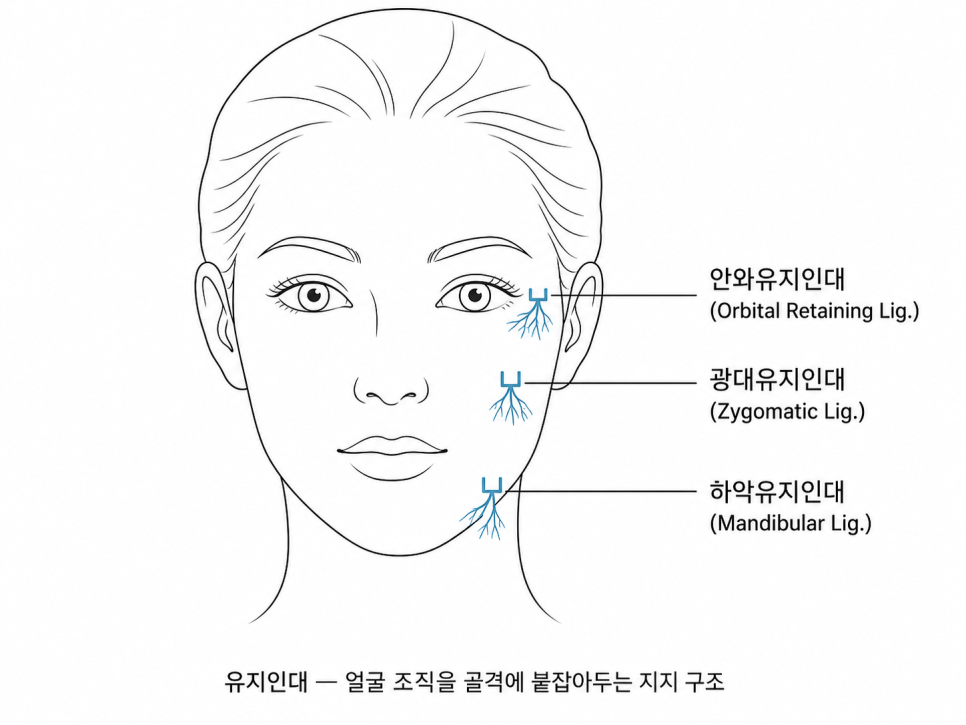
It is not only the ligament that has stretched
People say the retaining ligaments loosen with age. In practice, atrophy of the surrounding fat, migration of soft tissue and change in the skeleton account for more than the ligaments themselves.
So improving an ageing face is a matter of readjusting the whole structure rather than pulling a ligament.
Filler supports; it does not pull
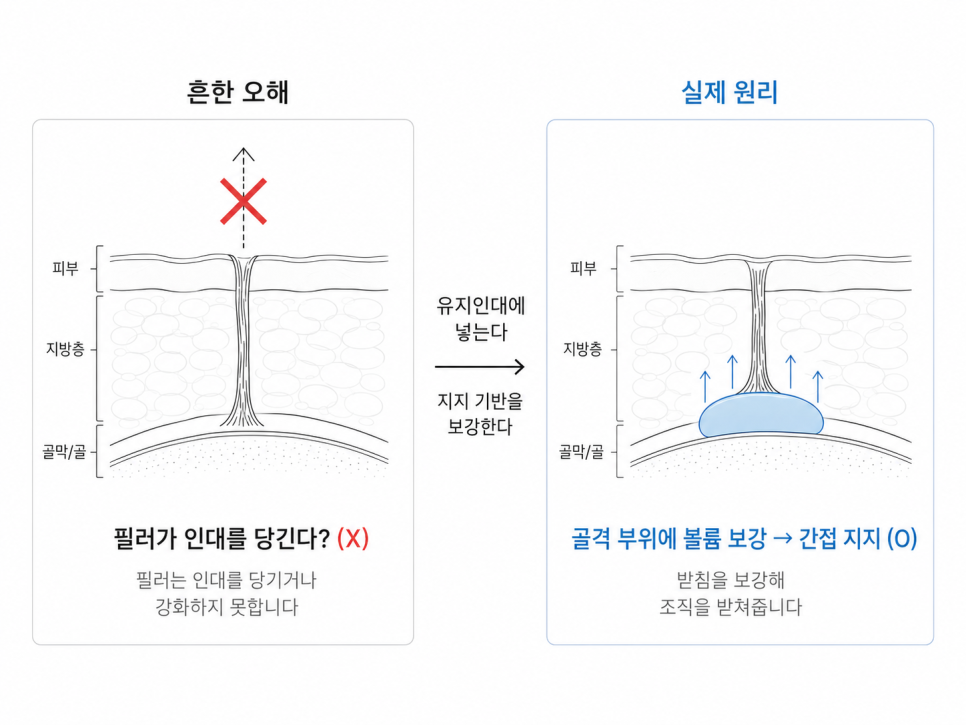
What is called retaining ligament filler mostly uses points above the periosteum: the cheekbone, the temple, the jawline. These sit close to where the ligaments attach, so filler placed there supports the soft tissue indirectly.
This is where the misunderstanding lies. Filler is a material that occupies space. It does not actually pull or strengthen a ligament. It is closer to reinforcing the footing under a post than to pulling the post upward.
"Reinforcing the supporting base of the retaining ligament" is more accurate than "injecting filler into the retaining ligament".
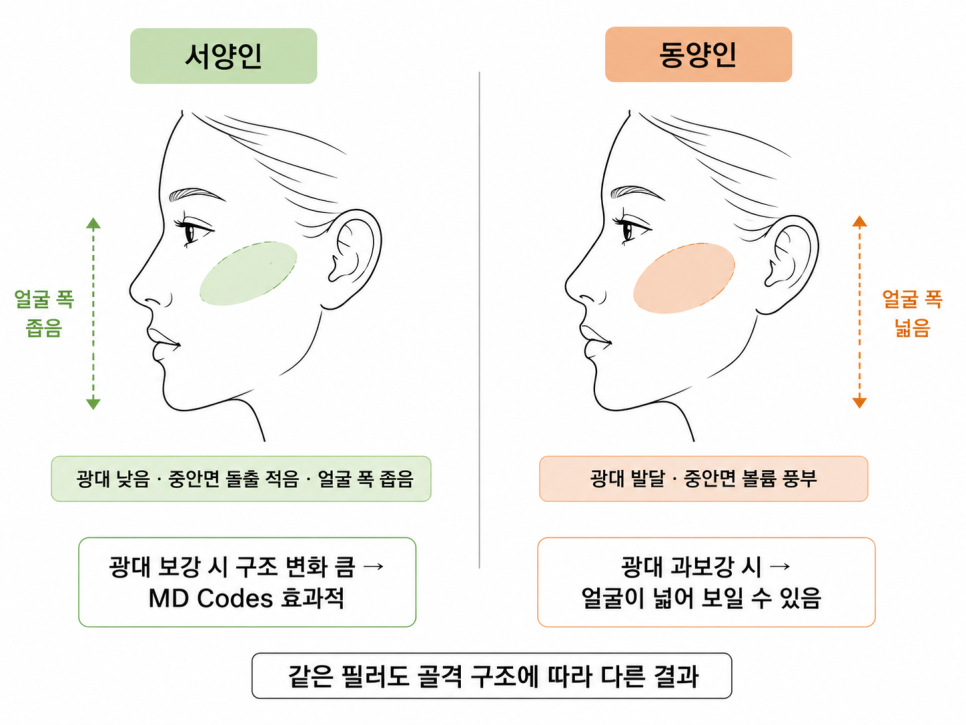
Western proportions do not transfer directly
The concept developed in the West first. Western faces often have less anterior midface projection, relatively lower cheekbones and a narrower width, so reinforcing the cheekbone and lateral skeleton produces a comparatively large structural change.
East Asian faces differ. The cheekbones are often already developed and midface volume is relatively full. Applying the same approach unchanged can make the face look wider or heavier rather than lifted.
It happens in practice: the filler clearly went in and volume increased, yet the face reads as larger. Filling a support point does not always produce a good result.
Different cause, different approach
Rather than fixating on the ligament, it comes first to analyse which region is actually driving the ageing.
- Descent of midface fat is the problem
- Collapse of the jawline is the problem
- Excess weight of soft tissue, rather than lack of volume, is the problem
The same complaint of sagging needs a different approach when the cause differs. Before deciding where to fill, establish what this face is short of and what it has too much of.
Frequently asked questions
Does filler lift the ligament?
Not directly. Volume is added at the bone where the ligament attaches, supporting the tissue indirectly. It eases sagging by reinforcing the footing rather than pulling upward.
Is it different material from ordinary filler?
The material is the same. The placement is different: at the skeletal points where the retaining ligaments attach, to create structural support.
Why can it make an East Asian face look wider?
Because the cheekbones are often already developed and midface volume is relatively full. Adding cheekbone or lateral volume to such a face can read as wider.
So should East Asian patients avoid it?
Not avoid it: avoid applying Western proportions unchanged. Assess the skeletal structure and the pattern of ageing to establish what is lacking and what is excessive first.
1 min walk from Dunchon-oryun Stn. Exit 1 (Line 9)
Tel 02-488-9119