
Filler in the lateral cheek, and it looks more saggy. Why?
"I had lateral cheek filler for hollowing and now it looks more saggy." The cause is usually not the product. More often the plan did not match the layer to the material. The same product gives a different result depending on the layer it goes into.

The lateral cheek is a pillar, not a space to fill
Many people think of cheek filler purely as filling a hollow. Anatomically the lateral cheek: outside the cheekbone and the lateral midface: acts as a structural pillar. When volume there holds, the dimension of the whole face holds with it.
When that support weakens, the nasolabial fold deepens or the lower face reads as heavier. The lateral cheek moves relatively little and creates the axis that lifts upward, so it needs a material that holds shape rather than one that fills softly.
Inject volume without regard to material properties and what was added settles with gravity, making the lower face look heavier. That is where "I had filler and it looks more saggy" comes from.
Look at the rheology, not the brand
People ask which brand is better. What decides the result in a given area is not the brand but the rheological properties of the filler. Two matter most in the lateral cheek: cohesivity and elasticity.
Rheology research has established that high elasticity correlates directly with the capacity to lift tissue (Choi MS, Archives of Plastic Surgery, 2020).
Higher is not better in itself; it has to match the area. Structural support areas(the lateral cheek, the cheekbone, the chin)favour higher values. Areas that need to spread softly to look natural(lips, under-eye, fine lines)favour lower. A highly cohesive filler in the lips feels like a firm foreign body; a highly elastic filler under the eye shows as a defined lump.
That is why brands divide their ranges by area. Which line within a brand suits your area comes before which brand.
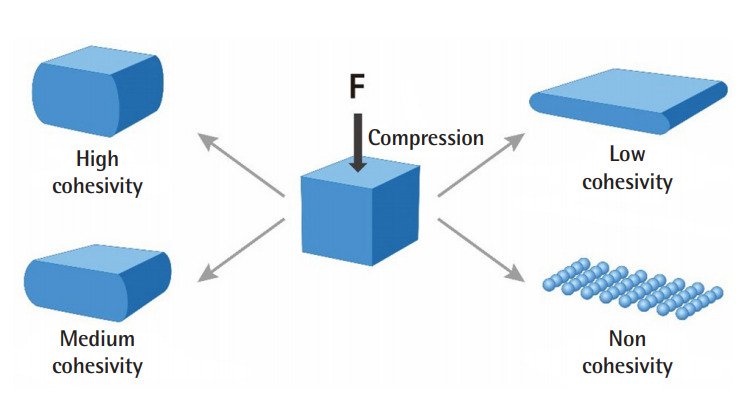
What happens when the properties do not match
- Too little elasticity and the volume settles downward with gravity and muscle movement
- Too little cohesivity and it migrates from the injection site, clumping or spreading
- A hyaluronic acid filler wrong for the area can absorb water over time and look overfilled
What kind of hollowing is yours
Diagnosis belongs in consultation, but there are observations worth noting beforehand.
- If the lateral cheek fills out naturally when you tilt your face up slightly in the mirror, descent may dominate over volume loss
- If the line from below the cheekbone to the jawline runs straight down in profile, lateral support may have weakened and flattening progressed
- If the lateral cheek does not rise when you smile but falls heavily toward the nasolabial fold, restoring structural support comes first
In practice volume loss, soft tissue descent and skeletal change are usually mixed. Hollowing after weight loss is often not only reduced fat but reduced skin elasticity and descent together. Treat self-assessment as a reference only.
The layer matters more than the product
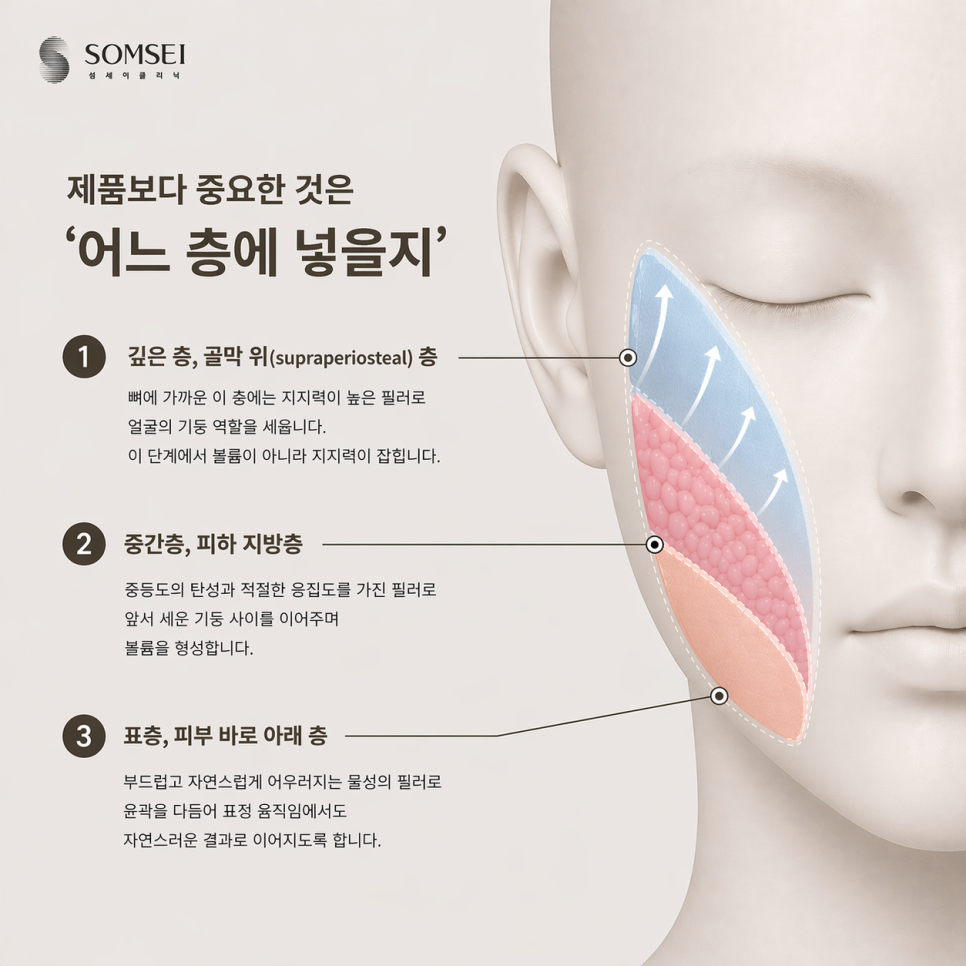
Combining different properties by layer is usually better for both stability and a natural result than solving everything with one product. Deeper layers need supporting strength; superficial layers need properties that produce a natural look.
A prospective analysis of 100 patients using multi-layer injection respecting the anatomical layers reported improvement in 97% at 12 weeks with 94% satisfaction: clinical confirmation that which property goes into which layer decides the result.
Conversely, one filler into one layer fills volume without creating the axis that lifts, which can read as a heavier face over time.
Worth asking at consultation
- Is my lateral cheek a volume problem or a descent problem?
- Which layer, and what properties of filler?
- Which product characteristics suit my condition?
- Cannula or needle?
- How is it managed if it clumps or I am unhappy with it?
The lateral cheek has a complex arrangement of vessels and ligaments, so a blunt-tipped cannula is generally recommended. Hyaluronic acid filler can be dissolved with hyaluronidase, so it is worth confirming the aftercare approach.
Frequently asked questions
How long does it last?
It depends on the filler, the layer and individual metabolism. A high-elasticity filler in a deep layer tends to last relatively longer.
Why does it settle downward over time?
The choice of layer matters most. A low-elasticity filler overfilled superficially can descend over time. Establishing support in the deep layer and building upward is recommended.
1 min walk from Dunchon-oryun Stn. Exit 1 (Line 9)
Tel 02-488-9119