
Ozempic face: managing a hollowed, sagging face after rapid weight loss
Ozempic face happens because the skin cannot keep up with the speed at which the fat disappears. If you lost weight on Wegovy or Mounjaro and your cheeks have hollowed and your face has dropped, this is you. You end up looking older than before the diet. I do not perform volume treatments while the weight is still moving. I have seen filled areas hollow out again too many times. Once the weight settles, I check whether the hollows smooth out when you lie down, and that result decides whether to fill or to lift.

Not long ago I met a patient in my consultation room who had lost 12kg over three months. When I congratulated her, she answered, "I hit my target weight, but the mirror gives me no joy at all. Only my face got old."
I see a great many patients with this concern lately, people who lost a lot of weight in a short time on drugs like Wegovy or Mounjaro. Overseas this facial change has a name, Ozempic face. They all tell me something similar: they expected to look better after losing the weight, and the face went the other way.
Let me say something first. Your face is not ruined. And filling it right away is not the answer either. Let me explain why.
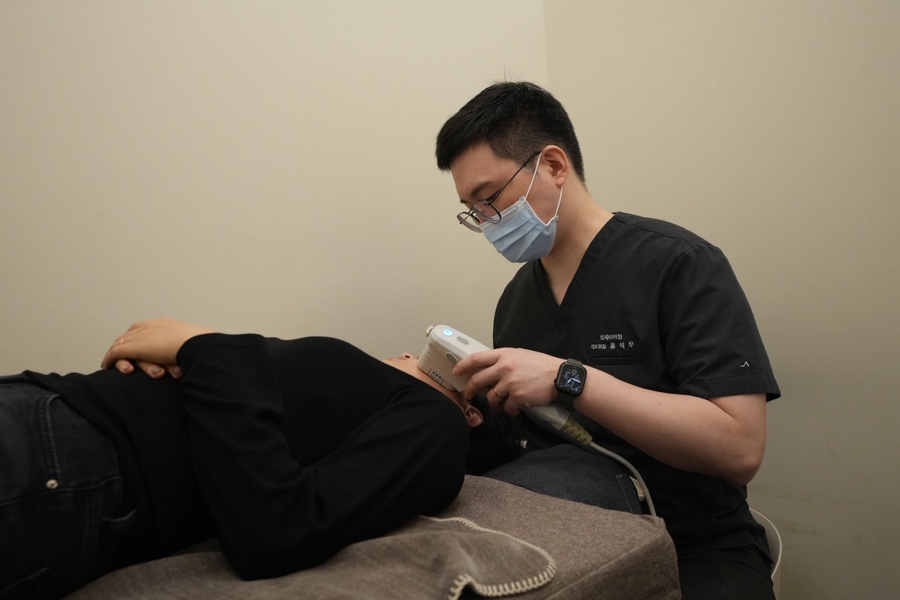
The speed gap between fat and skin
The face has fat layers too. The fat in the cheeks, the temples and under the eyes shrinks along with your body weight, and up to that point everything is natural. The problem is speed. Fat can disappear within a few months, but skin cannot shrink back that fast.
Think of a balloon. Let the air out and the air is gone in seconds, but the stretched rubber does not snap back right away. The face works the same way. The fat that filled it from the inside is gone while the skin that wrapped it from the outside remains, so the cheeks hollow and the leftover skin folds, making the nasolabial lines look deeper.
When I give this explanation in clinic, some patients ask, "So is my skin damaged?" No. The skin has not gone bad; it is skin that has not yet caught up with the volume that was lost. If you believe it is damaged, you feel rushed. If you understand it as a matter of speed, you can keep to the right order.
The mirror check you do lying down
There is one thing you can try before coming to a clinic. Just lie down on the bed and look at your face in a hand mirror. I look at exactly the same thing in my consultation room.
Sitting up, you cannot tell whether the slack look comes from lost volume or from sagging skin, because gravity is pulling both down together. Lie down and gravity drops out, leaving only one of the two.
If the line that looked slack largely smooths out when you lie down, the problem is mainly volume. Simply lying down has filled in some of the space the fat left behind. If, on the other hand, it stays exactly where it was, sagging is part of the picture. And the bigger the difference between sitting and lying, the stronger the sign that the skin can no longer hold the weight.
Why does this difference matter? Because if you only add volume to a face that is sagging, the weight increases and the face can end up looking even more droopy.
Why I postpone treatment while the weight is still dropping
In consultation there is something I ask before I even look at the face. "Are you still losing? Has your medication moved to the maintenance dose?" I need that answer before I can decide whether to treat that day.
If the weight loss is still in progress, I do not treat that day. The reason is simple. Whatever we fill now will hollow again as more weight comes off. A few months later the same area gets filled again, you have paid twice, and the result is less than one treatment's worth. Is there any reason to take that route?
When I say this, patients ask, "So I can do nothing in the meantime?" There is plenty. Keep up moisturising and sun protection, and combine enough protein with strength training. It sounds unglamorous, but the condition of your skin during this period decides how the later treatments turn out. If you are planning to fly to Korea for treatment, this is also why I suggest timing the trip for after your weight has stabilised rather than while it is still dropping.
What I check once the weight has settled
Once your weight has stayed in the same place for a couple of months, that is when we start talking about treatment. The mirror check is something I do in rather more detail in the consultation room. I go area by area, comparing how the hollows and the folds change between sitting and lying, and put it on record. Only after seeing all of that can I decide whether to fill or to lift.
If hollowing is the main change, we fill. That can be done with filler, or with collagen-stimulating skin boosters such as Juvelook or Olidia. If sagging is also present, we first address the loose skin with lifting, or run lifting alongside the volume treatment.
| Filler | Collagen-stimulating skin booster | |
|---|---|---|
| When the effect shows | Right after the treatment | Gradually over several sessions |
| How it is maintained | Filled at once, lasts until absorbed | Built up through repeat sessions |
| Best suited for | One clearly hollowed area | A face that has flattened broadly overall |
A face after weight loss rarely hollows in just one spot. So for a face that has flattened broadly and shallowly I think of boosters first, for a single clearly sunken area I think of filler first, and I often combine the two.
And I do not do everything at once. A post-weight-loss face keeps changing over the following months, so doing one step, watching, and then adding where it falls short gives a more stable result. That is the same reason I do not stack procedures into a single visit.
How the approach differs by area
Even on the same post-weight-loss face, each area hollows in its own way. The most common is the mid cheek. It tends to flatten broadly, so filling it over several sessions with a collagen booster looks more natural. When the temples hollow, the upper face looks narrow and the cheekbones stand out; here, filling a lot at once looks artificial, so I go in small amounts, divided over time.
Under the eyes, I look at things differently. When the fat there disappears, the area darkens like dark circles, but the skin is so thin that the choice of filler layer and amount matters more than anywhere else. This is the area I approach most conservatively. Next to the nasolabial folds, hollowing and sagging overlap, and filling only there can make the mouth area look heavy. So I assess the support from the cheek at the same time.
Patients often ask about order as well. When the upper face (temples and cheeks) is addressed first, the lower face (nasolabial area and around the mouth) often improves along with it. So my order is to check the top first rather than fill from the bottom up.
Choosing a lifting device when sagging is also present
Patients who also have sagging ask about lifting next. Ultrasound (HIFU) devices create thermal coagulation points in the deep layers to pull, while radiofrequency (RF) devices deliver heat broadly to the dermis so that collagen is built again. Which device is used depends on how loose the skin is and how thick it is.
A face after weight loss is a little different, though. It is not one layer that flattens; the fat layer and what sits above and below it come down together. So pulling one layer with one device barely shows. Quite a few of the patients who had Ultherapy or InMode and found the result disappointing fall into this group.
Somsei Layered Lifting
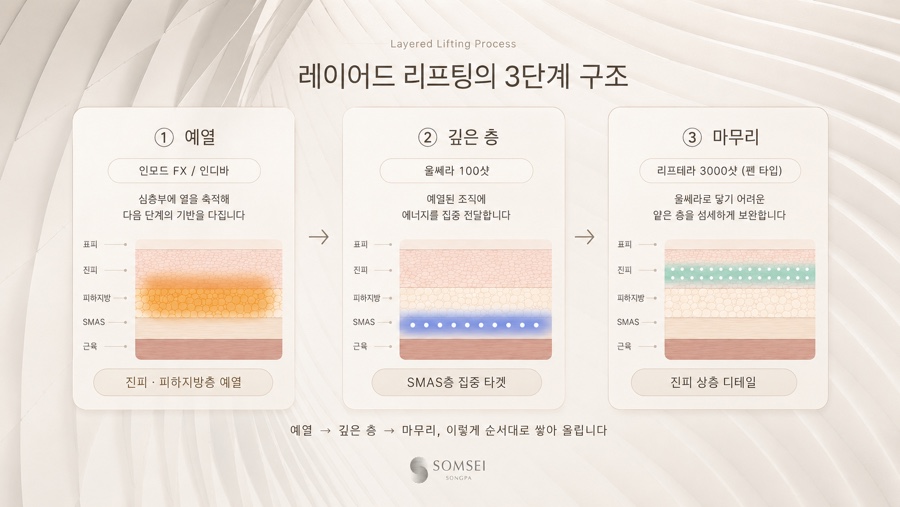
That is why, for a face where several layers have flattened together, we use Layered Lifting. Rather than finishing with a single device, we stack the work in order, from the deep layer up to the shallow one.
Stage 1 pre-heats the lower face with InMode FX or INDIBA. Building heat in the deep tissue first means the next stage gets more done with the same energy.
Stage 2 targets the deep layer with 100 shots of Ultherapy. Because the tissue is already warmed, the shots go only where they are needed and fewer of them are wasted.
Stage 3 finishes the shallow layer with 3,000 shots of Liftera. It works down to the fine areas such as around the eyes and the forehead, so no border shows between the treated zones.
There is a reason this order suits a face after weight loss. Where the volume has gone, the skin is thinner, so putting strong energy in all at once asks a lot of it. Starting with pre-heating and splitting the rest across stages makes the same total energy easier to take. Of course not everyone gets all three stages. When the sagging is mild, the pre-heating and the finishing pass are sometimes enough.
There is one more thing I look at: the texture of the skin surface. After rapid weight loss the skin often turns rough, so restoring hydration and texture with skin boosters, separately from the lifting or the volume work, changes the overall impression.
How the 12kg patient progressed
Let me go back to the patient with the 12kg loss I mentioned at the start. At her first visit she was still titrating up and her weight was still coming down. She had come in a hurry because her cheeks looked so hollow, but we did no treatment that day and arranged to meet again.
She came back about two months later. Her medication had moved to the maintenance dose and her weight had stayed in the same place. Looking again, her cheek hollows smoothed out considerably when she lay down, so volume, not sagging, was the larger part. We did two sessions of collagen booster, and six weeks later, looking at where she stood, added a small amount of filler next to the nasolabial folds.
Done in stages like this, the whole course takes three to four months. Slower than finishing in one go, yes. But a post-weight-loss face keeps changing over those months, so I count the time spent checking in between as part of the treatment. Better that you never need to come back for a refill than that I finish fast.

When Ozempic face needs no treatment
Some people come in saying their face has changed since the weight loss, and once I have seen them I end up not raising treatment at all. These are people whose facial fat was generous to begin with. Losing the weight has sharpened the outline, so filling would only take them back to the impression they had before.
If your face has slimmed down after the weight loss and you are happy with it, this column is not for you. People who started with fuller facial fat often end up with a clearer outline and a better impression, and I do not suggest filling for them. Treatment is for when the mirror shows a change that bothers you; it is not a step that automatically follows weight loss.
The range treatment can reach
Many patients bring an old photo to the consultation and say they want to go back to that. But that photo is a face with the weight still on it. Treatment cannot recreate that state as it was. It fills the hollows and tidies the sagging so that the face at your current weight looks natural. Trying to fill to the volume of your heavier days leads to overcorrection, and that looks stranger.
Skin care during the weight loss
When I tell patients to come back later, they ask what to do in the meantime. How you spend this period affects the later results quite a bit. If you lose muscle along with the fat in a rushed loss, facial sagging gets worse, so keep your protein intake up; strength training that preserves muscle affects not just your figure but the firmness of your face.
Sun protection is the most reliable way to protect the elastic fibres, and it matters even more while the skin is thinner. The same goes for moisturising: leave a rough surface alone and fine lines settle in. Rather than adding one active product after another, steady basic moisturising serves you better.
If you have been prescribed a GLP-1 medication, follow your prescribing clinic's guidance first, and add a dermatology consultation when the facial changes start to bother you. The two kinds of care do not conflict.
Frequently asked questions
I am still losing weight. Can I get filler now?
If your weight is still going down, I do not treat that day. Whatever we fill will hollow again as more weight comes off, and the same area ends up filled repeatedly. If you are flying to Korea for treatment, it is better for both cost and results to plan the trip for after your medication has moved to the maintenance dose and your weight has stabilised.
Can lifting and filler be done together?
When sagging and hollowing coexist, we do sometimes combine them. But rather than packing everything into the same day, spacing the steps in order and checking one stage at a time gives a more stable result.
Does Ozempic face improve on its own with time?
Once the weight stabilises, the skin adapts to some degree, and the younger and more elastic the skin, the greater the recovery. But there are limits to how much stretched skin and lost volume come back on their own, and how many months are worth waiting differs by age and skin condition, so I advise each patient differently.
I am planning to lose weight. Is there anything to do in advance?
I do not recommend filling in advance. Keeping up sun protection and moisturising during the weight loss, together with protein intake and strength training, is what decides the treatment results afterwards.
When can I start lifting after the weight loss?
The standard is the same as for volume treatment: the weight has to have held for a couple of months. That said, lifting builds up gradually, so starting a little early costs you less. If most of the weight is off and you have moved to the maintenance dose, it is reasonable to come in and talk it through.
Only my cheeks went hollow. Is filling the cheeks alone enough?
Filling only the cheeks can leave that one area standing out and looking odd. If the temples or the area beside the nasolabial folds have flattened too, I fill in divided amounts while watching the balance. How far the flattening reaches is something I check by comparing you lying down and sitting up.
The fat left my face, so is fat grafting the answer?
It is one of the options, but grafted fat that has taken can also change along with your weight. It is a decision to make after the weight has been stable for long enough, not a procedure to rush into right after the loss.
1 min walk from Dunchon-oryun Stn. Exit 1 (Line 9)
Tel 02-488-9119