
Why Liftera and Ultherapy give different results even when the total energy is similar
Comparing HIFU by shot count or by total joules often fails to match what actually happens. The same amount of energy produces a different thermal effect in tissue depending on the size of the focus it is delivered into and the density at which it arrives. Having used Liftera for a long time, I then used Coolsonic myself and watched the difference, which I have set out here along two lines: the energy arithmetic, and the size of the focus.

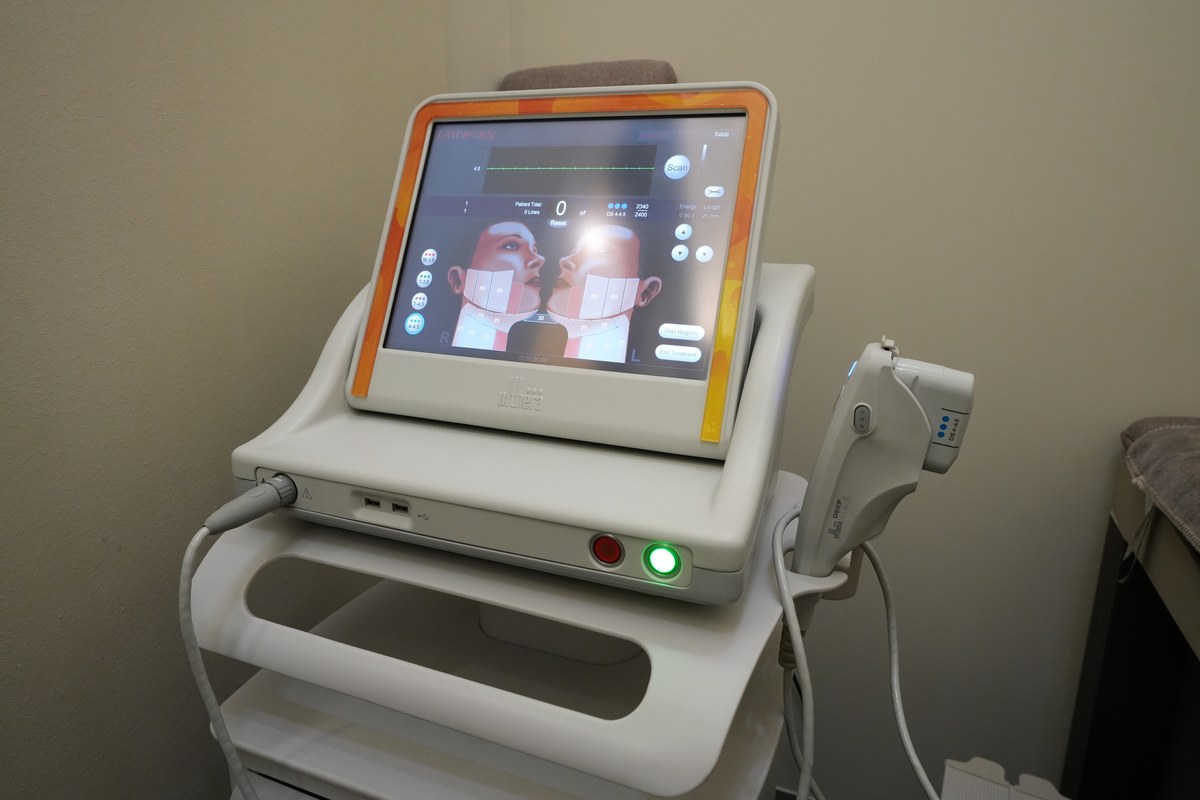
Our clinic has been a heavy user of Liftera for years. A pen-type HIFU device can be brought close to the curves of the face and into narrow areas, and I can adjust where each shot goes and how far it spreads area by area.
As I kept treating with it, though, I found that whatever the change looked like right after the session, how long it held was disappointing next to Ultherapy in some patients. So rather than comparing shot counts or the energy value on the dial, I went back to thinking about the form in which ultrasound energy is delivered into tissue and what kind of thermal coagulation zone it leaves behind.
Working out the energy in one Ultherapy line at 4.5mm
The setting I mostly used with the Ultherapy 4.5mm transducer was 0.9 J. Ultherapy forms 17 thermal coagulation points (TCPs) along a single line.
Do the simple arithmetic and one line carries 0.9 J × 17 = 15.3 J.
With the Liftera 4.5mm tip my setting was 1.0 J. Look at total energy alone and Liftera at 3,000 shots and Ultherapy at 300 shots come out roughly similar.
Why a similar total energy still gives a different result
What matters is not only how much energy goes in altogether. The same energy delivered into a focus of a different size, in a different form and at a different density, can produce a different thermal effect in tissue.
To put it in everyday terms, Liftera is closer to dotting small points densely with a fine pen. Ultherapy builds a more defined thermal coagulation point with each shot and concentrates the energy at that depth.
That the size and the uniformity of the thermal coagulation point are what separate one device from another is also covered in the consensus paper on the safety of microfocused ultrasound with visualisation.
So I do not think comparing HIFU by total joules or total shot count is enough to understand what a treatment will actually do.
What the acrylic plate showed: Coolsonic dots larger than Liftera dots
This is also the point that drew my attention once I started using Coolsonic. Put Liftera and Coolsonic side by side and the size of the dot each single shot creates is not the same.
If Liftera feels like dotting with a fine pen, Coolsonic is closer to dotting with a thicker marker. Firing both into an acrylic plate, the dot from a single shot came out larger with Coolsonic than with Liftera.
I would not read the dot size on an acrylic plate as the same thing as the size of the thermal coagulation point formed in living tissue. I took it only as a way of seeing with my own eyes that a single shot builds a focus of a different character.
Why cooling the epidermis widens the range of energy settings
HIFU gathers ultrasound at a target depth to create heat, so two things always ride together: delivering enough energy to the treatment depth, and holding down thermal injury at the skin surface.
The cooling system in Coolsonic works in the direction of reducing that thermal load on the epidermis. In my own hands it let me set as high as 1.4 J, above what I use with Liftera.
Cooling does not remove the possibility of thermal injury to the epidermis. The energy and the way the shots are placed still have to be chosen according to skin thickness, the amount of fat, the bone and anatomy underneath, and the area being treated.
The three things that work together in Coolsonic
What caught my attention about Coolsonic is not that its energy runs stronger than Liftera. It is that these three sit together in one device.
- The fine access of a pen-type HIFU device
- The relatively large focus made by each single shot
- A setting range that reaches higher energies through epidermal cooling
Nor would I say Ultherapy is strong because a lot of total energy goes in. The character of that device is that it gathers ultrasound at one depth and builds a meaningful thermal coagulation point. Seen that way, Coolsonic keeps the fine access of a pen-type device while carrying the focus of the single shot and the setting range along with it.
Having used Liftera for a long time is what let me see the difference at all. In the end what I was looking at was not how much energy goes in, but the kind of focus that energy is gathered into.
How I use this comparison in consultation
Many patients ask about shot counts. They had a certain number of shots at a clinic at home or at another clinic in Seoul, and they want to know how many they get here. I tell them the shot count on its own does not let me answer. What depth, which tip and how many joules have to come with it before two treatments can be compared at all.
Where the skin is thin, or where the tip sits right over bone, the ceiling I can set comes down. That holds even with cooling. So even on the same device I use different values in different areas.
With HIFU, is a higher shot count better?
Shot count on its own is hard to judge by. Even at the same total energy, the thermal effect in tissue changes with the size of the focus and the energy density. What depth, which tip and how many joules have to come with it before two treatments can be compared.
Are Liftera at 3,000 shots and Ultherapy at 300 shots the same treatment?
Converted into total energy the two can land on similar figures. But the size of the thermal coagulation point each single shot creates, and the way that energy is concentrated, are different, so I would not call them the same treatment.
What is a thermal coagulation point (TCP)?
It is the spot where ultrasound gathers to a point and the tissue at that depth coagulates. As that spot heals, collagen rearranges itself. The size and the uniformity of the spot differ between devices, and that difference bears on the result.
Coolsonic has cooling, so is it painless?
The thermal load on the epidermis is reduced, which is not the same as pain going away. Deep settings such as 4.5mm, and places close to bone, still hurt even with cooling.
If there is cooling, can the energy simply be turned up?
No. The ceiling changes with skin thickness, the amount of fat, the bone structure and the area treated. Even on the same device I use different values in different areas.
Does the dot size on an acrylic plate mean the same as the treatment result?
It cannot be read that way. The size seen on an acrylic plate does not transfer directly to the size of a thermal coagulation point in living tissue. I take it as a reference for seeing with my own eyes that a single shot builds a focus of a different character.
1 min walk from Dunchon-oryun Stn. Exit 1 (Line 9)
Tel 02-488-9119