
Why a bad night’s sleep makes a treatment hurt more
The same treatment at the same settings produces very different pain on different days. The people who found it unusually painful have something in common: they had not slept properly the night before.

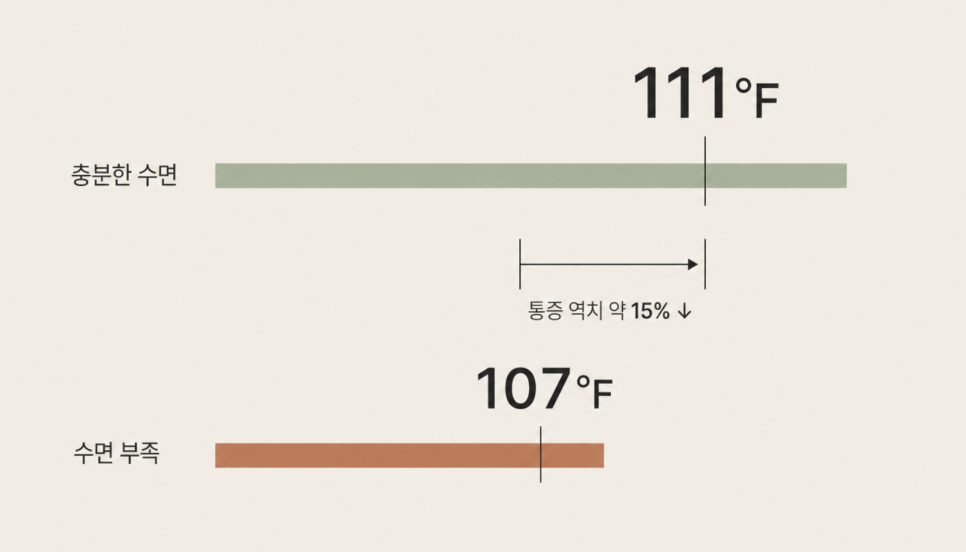
A 2019 fMRI study by Krause and Walker at UC Berkeley, published in the Journal of Neuroscience, measured the brain’s response to a pain stimulus after 24 hours of sleep deprivation. With the same thermal stimulus, the pain threshold fell by about 2.2 to 2.8°C: pain began at a stimulus roughly 15% weaker than before.
Pain is registered by the brain, and the brain’s state differs with the day. That is why sleep before a treatment is not a light variable.
Why sleep loss has such a strong effect
In human evolution, not sleeping deeply mostly meant an unsafe environment: predators, conflict, a night that had to be watched. In that context, sleeping deeply was the greater risk.
With sleep loss, the autonomic balance shifts toward sympathetic dominance and stress-related catecholamines such as noradrenaline rise. Heart rate, blood pressure and muscle tone go up, and sensitivity to external stimuli rises with them. A useful adaptation in a primitive environment; on a treatment couch it presents as more pain. The same stimulus arrives and the body reads it as more threatening.
Pain is completed in the brain, not the skin
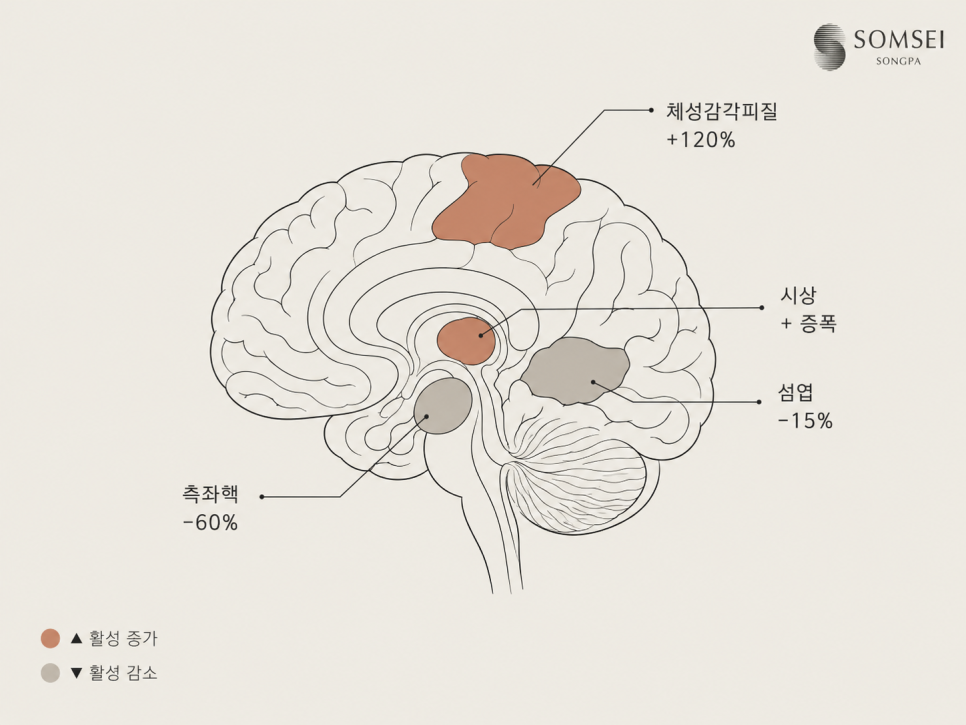
It is easy to think of pain as a sensation arising in the skin. More precisely it is an experience the brain interprets. Nociceptors detecting a stimulus is only the start; the signal passes through the spinal cord and is processed across several brain regions before it becomes what we know as pain.
Two changes matter. First, the primary somatosensory cortex: which registers the location and intensity of pain: becomes more reactive, so the incoming signal is amplified. Second, the regions that evaluate and modulate that signal become less active. Normally they recruit the endogenous opioid system to damp excessive pain: a built-in analgesic. The researchers put it this way: more pain signal arrives, while the system that usually evaluates and damps it is working less.
Different from stress-induced analgesia
People ask whether stress does not reduce pain. In an acutely life-threatening situation the HPA axis activates rapidly and endogenous opioid release rises, briefly reducing pain. That is stress-induced analgesia.
Sleep loss works differently. It creates a sustained low-grade stress state in which descending pain inhibition declines over time, and central sensitisation raises the excitability of the whole pain-processing circuit. Acute stress blunts pain temporarily; chronic sleep loss lowers the threshold itself. The mechanisms run in opposite directions.
Sleep and pain run both ways
Poor sleep worsens pain, and pain prevents sleep. That is why many people with chronic pain also have disturbed sleep. Sleeping well through the recovery period after a treatment is not only about rest: it breaks that loop.
What this means for how a treatment is planned
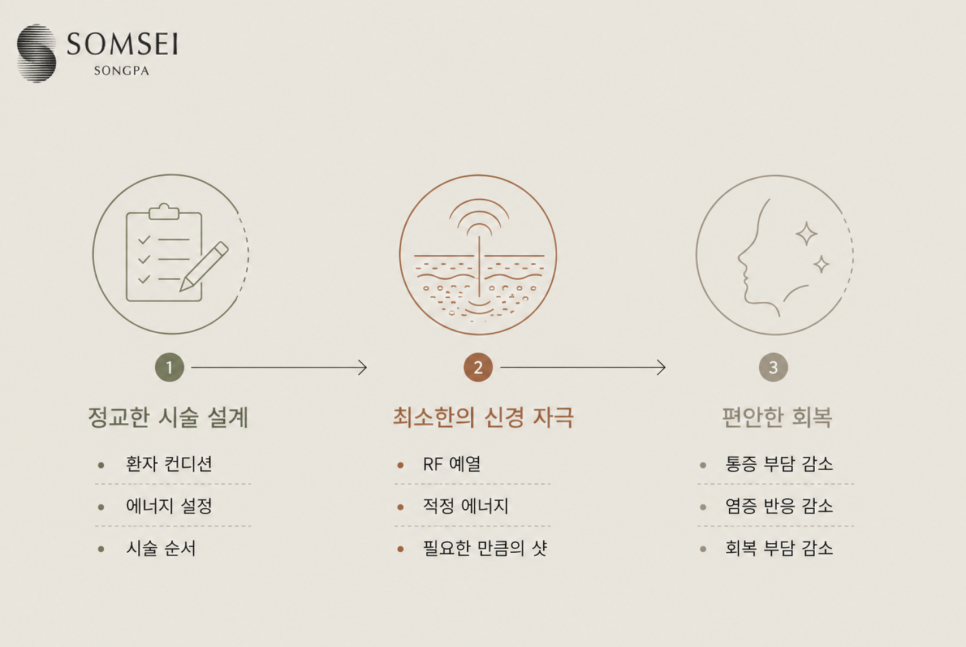
"That did not hurt much" is not only a comfort report. It means the same result was produced with less neural stimulus, and with that, less inflammatory load and less recovery burden.
Pre-heating with RF before HIFU sits in this logic: energy delivered into warmed tissue achieves the same effect with fewer shots, and the pain burden falls with the shot count. Not pushing energy aggressively in RF microneedling follows the same reasoning: stronger does not mean better, and it can leave the skin sensitised for longer.
And the strongest pain management a patient can prepare themselves is sleep the night before.
Frequently asked questions
How much sleep before a treatment?
Seven to eight hours or more is generally recommended, but quality matters as well as quantity. Without enough deep sleep, the pain modulation system does not fully recover. Broken or shallow sleep can leave sensitivity raised even if the hours look sufficient.
I could not sleep. Should I reschedule?
A day when you are in good condition is better. If rescheduling is difficult, tell us in advance: energy settings can be adjusted conservatively or pain relief options added. It is adjustable rather than all-or-nothing.
Would a painkiller beforehand help?
It can reduce peripheral pain signalling to a degree, but it does not address the central changes sleep loss produces. A painkiller is not a substitute for sleep. Discuss what and whether to take beforehand.
Anything else that raises sensitivity?
Excess caffeine, alcohol and dehydration all push sensitivity up. Adequate hydration and a light meal on the day help. Extreme anxiety also amplifies pain perception.
Does sleep after the treatment matter?
Yes. Collagen resynthesis, resolution of inflammation and normalisation of pain signalling happen largely in deep sleep. The night after and the following few nights matter for both result and recovery.
1 min walk from Dunchon-oryun Stn. Exit 1 (Line 9)
Tel 02-488-9119