
Coolsonic and Liftera: what actually differs between two pen-type HIFU devices
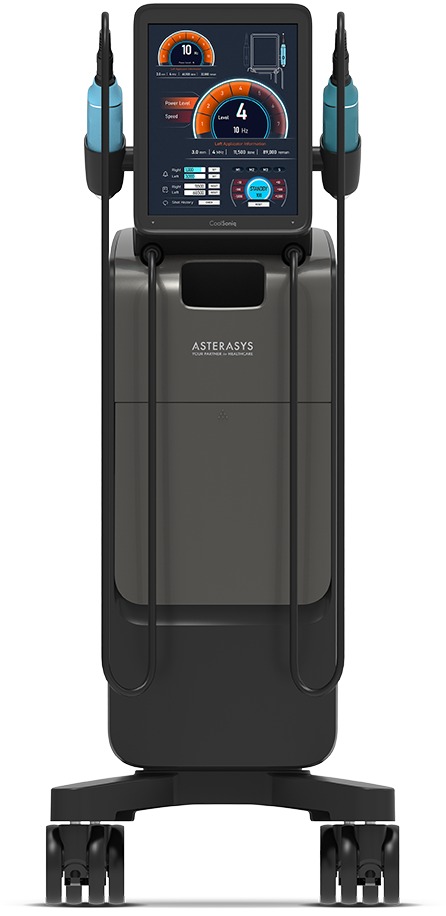
Coolsonic and Liftera are not better or worse than one another. They are for different places. Both are pen-type HIFU devices made by Asterasys, and both let me place shots one at a time along a curved surface. What differs is cooling. Coolsonic keeps the skin contact tip cold, so the same energy feels different at the shallower depths. For patients sensitive to pain, or when I am working on a small area only, I reach for Liftera. For thick skin and a thick fat layer, or for patients who felt Liftera did not do enough, I look at Coolsonic.

Patients who have had Liftera sometimes tell me it was "not bad, but nothing showed." Patients who have had Ultherapy tell me the opposite: "it worked, but I could never go through that again." After hearing both often enough, I started to think there is a gap sitting between them.
Coolsonic is the device I brought in to fill that gap. When I take on a new device, I look at what happens when I fire it myself and at how much my patients can tolerate, not at the catalogue.
Why Liftera and Coolsonic come from the same manufacturer
When I mention that I have brought in Coolsonic, some patients ask whether that means I no longer use Liftera. The two devices are made by the same company, Asterasys. Coolpaze, their cooled radiofrequency device, comes from the same company as well. So this column is not about which brand is better. It is closer to why one company released two devices with different characters.
The cooling in Coolsonic is registered as a patent (Korean patent No. 10-2842717) and works by keeping the ultrasound generator from overheating so that the skin contact surface stays cold. Under Korea's MFDS the product category is a focused ultrasound stimulation system, and the approved purpose is coagulating tissue with focused ultrasound for lifting.
Why a pen-type handpiece suits curved areas
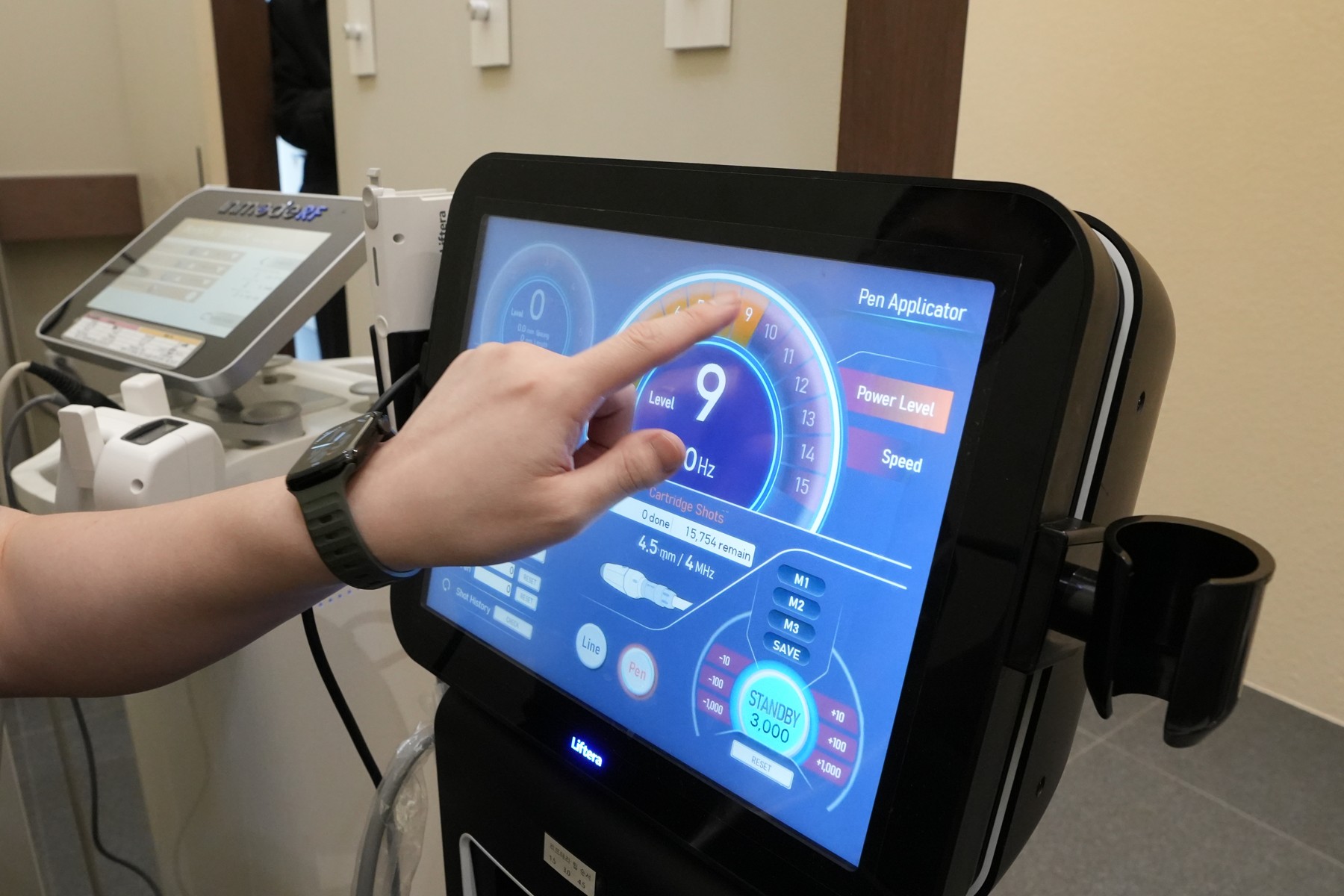
HIFU gathers ultrasound at a single point under the skin and creates a thermal coagulation point. As that point heals, collagen rearranges itself. Coolsonic and Liftera both work at 1.5, 3.0 and 4.5mm.
A face is not flat. Around the eyes, beside the nasolabial folds, under the jawline, there are folds and hollows. A wide cartridge handpiece does not sit evenly on skin like that. Where it does not make contact, less energy goes in. A pen-type tip has a small contact surface and follows the curve. Placing one shot at a time, I can check where each one lands.
The trade-off is time. Covering a broad surface takes longer, and if the operator does not remember where and how many shots were placed, the two sides come out different.
Why it is hard to raise the output on Liftera
For narrow, sensitive spots like the eye area or the nasolabial fold, Liftera is the device I have used the longest. I still use it. I can place it precisely on uneven ground, and the pain burden is low enough that I can finish at a level the patient can sit through.
The problem appeared when I wanted to push a little further. On a patient with a heavy jawline, raising the energy hurts that much more. When I can see someone enduring it, I end up lowering the output. On days that ended that way I did not feel settled once the treatment was over. And at the next visit I would stop at the same point again.
That is not the fault of the device. I was asking a device built for comfort to deliver strong output.
How cooling changes pain at each depth
The first thing I check with a new device is how much patients can tolerate. Lowering the surface temperature changes how the same energy feels, but the difference was not the same at every depth. Here is what I have felt while treating.
| Depth | Layer mainly targeted | Sensation compared with Liftera |
|---|---|---|
| 4.5mm | Around the SMAS | Somewhat more painful |
| 3.0mm | Deep dermis and subcutaneous | Similar or less |
| 1.5mm | Dermis | Less |
The shallower the depth, the more patients feel the benefit of cooling. At 4.5mm it hurts even with cooling, and more so where bone is close. Pain varies with the area, skin thickness, fat volume, nerve course and the settings, so this order does not hold for everyone.
I compared the shot patterns as well. Firing both into an acrylic plate at the same settings, the Coolsonic dots come out larger than the Liftera ones. But acrylic is not skin. Heat spreads differently, so a bigger dot on acrylic does not let me say the thermal coagulation point inside skin is bigger by the same amount. What I confirmed there stops at one fact: the two devices have different shot patterns.
What decides between Liftera and Coolsonic
There are days when I hear the same sentence about a jawline losing its line and recommend Liftera to one patient and Coolsonic to the next. Here is what makes that difference.
When I use Liftera. For patients sensitive to pain. If "one moment please" comes up even once during the treatment, I cannot do as much as I planned that day. And if I make someone endure it to the end, there is no next appointment. Liftera is also better when I am working only on narrow, curved spots like the eye area or the nasolabial fold. For a patient whose sagging is mild and who comes for upkeep, there is no reason to reach for the stronger device.
When I use Coolsonic. For patients who have had Liftera and felt the change fell short. Repeating the same device more times usually gives the same result. Patients with thick skin and a thick fat layer belong here too. When the layers are thick, shallow energy scatters before it arrives. Patients who want strong lifting but have been putting it off out of worry about Ultherapy pain are also worth a consultation.
Two cases where I do not recommend HIFU
There are days when a lifting consultation ends with me saying not to do it. That is when volume loss, rather than sagging, is the main cause. HIFU on that face can make it look more hollow. Put 4.5mm in hard on a thin face and the jawline tidies up while the cheek caves in. For these patients I lower the output or change the depth.
When someone has had HIFU on the same area recently, I ask for the date first. If treatments overlap before recovery has caught up, the result gets blurred. If you are flying in for the treatment, tell me the date of your last session when you book rather than on the day.
What I check before choosing the device
Many patients come in asking me to tighten the jawline. That sentence alone does not tell me which device to use, so there are a few things I look at first in the consultation. The first is which layer the sagging started in. Whether the skin surface has stretched, whether the SMAS has descended, or whether fat has shifted changes the device I use.
I look at skin thickness and fat volume together. I also ask in advance how much pain you can take. If I start without asking, I end up lowering the output halfway through, and the treatment turns into something other than what was planned.
Where nerves run and where bone sits close to the surface, I set depth and output separately. Deciding where not to place a shot takes as long as deciding where to place one.
Recovery and when the change appears
Redness or swelling right after the treatment is possible and usually settles within a few days. Some patients have a tingling feeling, or tenderness when pressed, for one to two weeks.
Collagen takes time to rearrange. The change comes over two to three months rather than right after the session. Some patients contact me at about a month to say it does not look very different. That point is still early. If you are visiting Korea, plan on judging the result at home, not before your flight back.
Rarely, a nerve is irritated and sensation becomes dull for a while. If something feels different from usual, it is better to come in and have it checked.
Which is better, Coolsonic or Liftera?
Neither is better. They are for different places. If you are sensitive to pain or want only a small area treated, Liftera. If your skin and fat layer are thick, or Liftera left you wanting more, I look at Coolsonic. I decide after checking in the consultation which layer the problem sits in.
Does Coolsonic replace Ultherapy?
They serve different purposes. Ultherapy places shots while the layers are visible on ultrasound imaging, and Coolsonic is pen-type, so it reaches curved areas well. Depending on the condition I pick one or split the areas between them.
With cooling, does it not hurt?
The pain does not disappear. What gets reduced is the surface heat. At 3.0mm and 1.5mm many patients told me it hurt less. 4.5mm still hurts.
When does it start to look different?
It comes over two to three months. If you add another session without waiting out that period, the recovery overlaps and the result becomes hard to judge.
How often can I have it?
It depends on the condition, but leaving an interval works better than treating the same area back to back. For upkeep I look at the skin when you come in and set the timing then.
If I have Liftera several times, does it add up to Coolsonic?
Repeating the same device more times usually gives the same result. If the change fell short because thick layers kept the energy from arriving, changing the approach fits better than adding sessions.
1 min walk from Dunchon-oryun Stn. Exit 1 (Line 9)
Tel 02-488-9119