
When neck lines come from posture rather than age
Neck lines track how many times a day you drop your head more closely than they track your age. Neck skin is thinner than facial skin and has fewer oil glands, so it dries out easily, and when the same spot folds over and over, collagen and elastic fibres weaken there first. Shallow horizontal lines and the vertical bands pulled up by muscle need different approaches.


A face consultation often turns into looking at the neck as well. Some patients have kept up with their skin diligently and only the neck reads as a different age. When I ask, it is rare to find someone who takes their sunscreen down onto the neck.
Why neck skin folds before the face does
Neck skin is thinner than the skin of the face and has fewer oil glands. Less oil means it dries out easily, and dry skin folds more readily under the same force. Add a day spent with the head down looking at a screen and the same spot folds again and again.
As the folding repeats, a mark that used to disappear when you straightened up starts to stay. Past that stage, collagen and elastic fibres weaken in that spot and the line sets.
What makes neck lines appear early
In a neck consultation I ask about the following five things. The more of them apply, the harder it is to hold a result with treatment alone.
- 1. How many hours a day you look at your phone
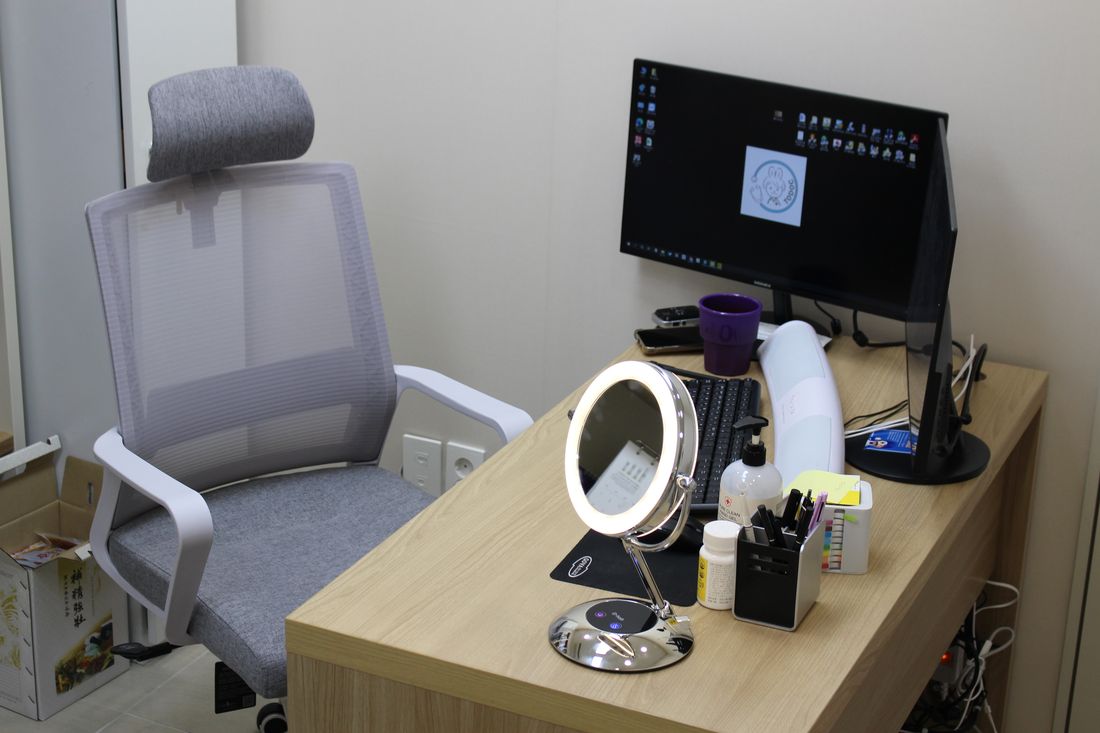
- 2. Whether your monitor sits below eye level
- 3. Whether you have a forward head posture
- 4. Whether sunscreen stops at the face
- 5. Whether you have lost weight quickly of late
The fifth one catches people more often than you would expect. When weight comes off and the skin at the front of the neck loses firmness with it, horizontal lines that were never there start showing up.
Why horizontal and vertical lines are separated
Not all neck lines are the same thing. Several shallow horizontal lines come mainly from dryness and repeated folding, so I go towards moisture and skin boosters. Thick vertical bands that stand out when you lift your chin or tense are the neck muscle pulling, so I look at the muscle. Skin sliding downward from a general loss of firmness is different again.
| Shape of the line | Usual cause | First direction considered |
|---|---|---|
| Several shallow horizontal lines | Dryness and repeated folding | Moisture and skin boosters |
| Vertical bands standing out under tension | Pull of the neck muscle | Botulinum toxin |
| Sliding downward overall | Loss of firmness | Lifting devices |
| One deep single crease | A long-set fold line | It does not smooth out on its own, so it is combined |
The last row is where expectations have to come down. A single crease that has been set for years does not disappear in one go. Aiming at making it shallower over several sessions is closer to what actually happens.
Why I talk about posture before treatment
The neck holds a result for less time than the face. Smooth out a spot that folds hundreds of times a day and, if the habit continues, it comes back within months. So a neck consultation starts with screen height and sun protection. If it looks like those will not change, I sometimes do not recommend treatment at all.
The easy changes are these. Lift the phone to eye level, put a riser under the monitor, and do not stop sunscreen at the jaw but carry it down to the collarbone. Those three alone change the rate at which new lines form.
FAQ
At what age do neck lines start?
Posture and sun exposure matter more than age. I see horizontal line consultations in people in their twenties who use their phones heavily.
Do I need sunscreen on my neck?
The neck is exposed as much as the face and few people apply anything to it. Rather than stopping at the jaw, carry it down to the collarbone.
Can a deep neck line improve?
A single crease that has set does not smooth out in one session. The approach is several sessions aimed at making it shallower, with posture corrected alongside so it holds.
How often does the neck need treating?
It depends on the type of line and its cause. If the posture habit stays the same, the interval gets shorter; if the habit changes, the interval lengthens.
2 min walk from Isu Stn. Exit 13 (Line 4·7)
Tel 02-517-9996