
Can you use sunscreen with acne-prone skin?
"Will sunscreen block my pores when the acne is already bad?" It comes up every summer. Acne-prone skin still needs UV protection — more so if it tends to keep marks. That does not mean any product, applied thickly.

Why it matters
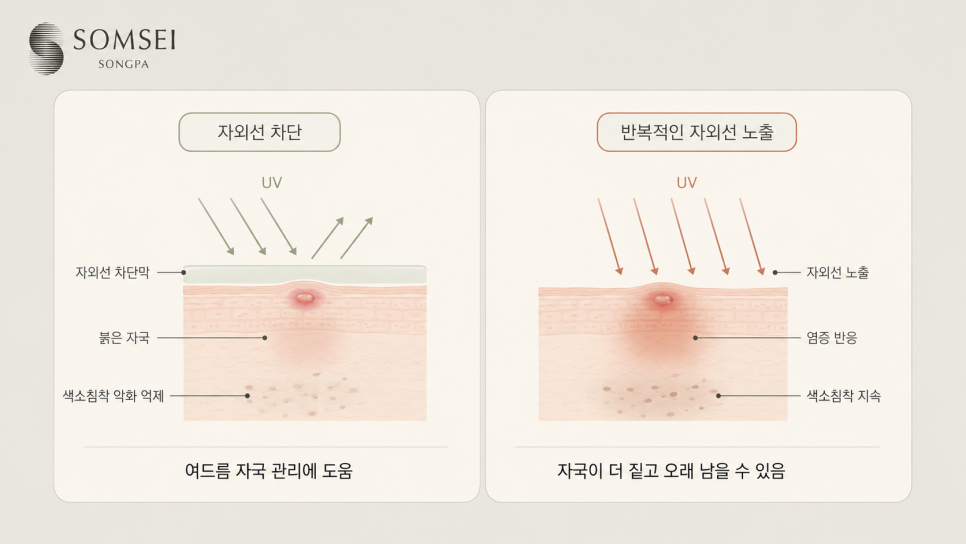
Acne does not end when the inflammation settles. Red marks or brown post-inflammatory pigmentation can remain, and skin with pigmentation exposed repeatedly to UV and visible light keeps those marks darker for longer.
Skin can look clearer right after sun exposure as it dries out. Over a longer horizon it works the other way, worsening pigmentation and irritation.
Sunscreen is not a treatment for acne, but it does the following:
- Reduces the darkening of post-acne pigmentation
- Protects skin made sensitive by retinoids or isotretinoin
- Reduces UV irritation after extraction or laser
- Helps manage marks remaining after treatment
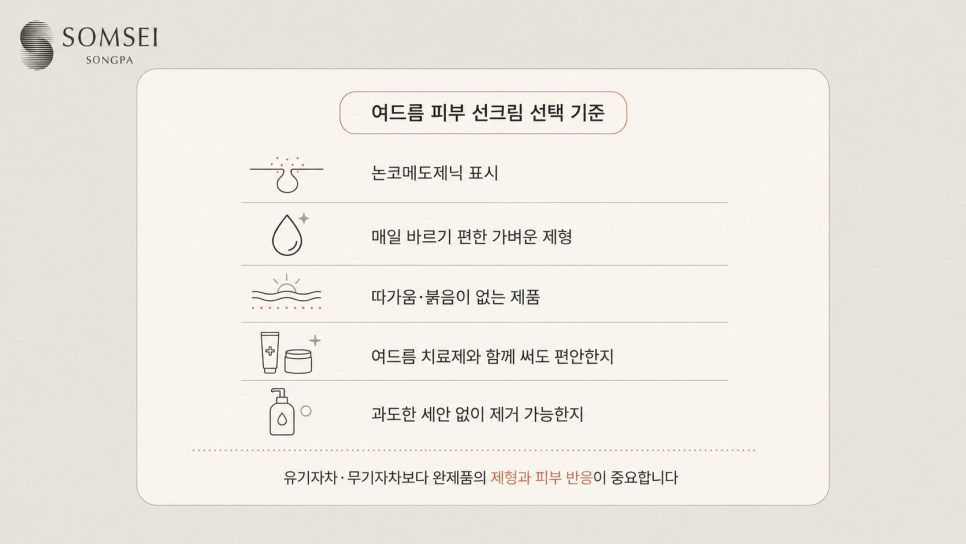
The American Academy of Dermatology recommends broad-spectrum, SPF 30 or above, and a non-comedogenic label for acne-prone skin.
It is the formula, not the filter
A breakout after sunscreen does not mean all sunscreens cause acne. A sunscreen is not only filters. Oils and silicones that control spread, humectants, emulsifiers, fragrance and film formers go in alongside.
- Is the formula light enough to apply every day
- Does it sting or redden after application
- Does it dry or pill with the acne treatment you are using
- Does it come off without heavy double cleansing
Non-comedogenic means a product designed or tested not to readily produce comedones. It is not a guarantee for everyone. Response varies with skin type, sebum output, season, what else is applied and cleansing habits. Trying a new product on the jawline or part of one cheek for a few days is one way to check.

If acne appeared after using it
Rather than layering on further products, establish what kind of reaction it is. Comedones increasing, an irritant dermatitis that stings and itches, a contact dermatitis that is red and burning, or acne that was already progressing: the response differs for each.
They all look like a breakout from outside, but they are managed differently. If it stings, reddens or itches every time, stop using it, and avoid adding several acne products at once.
Frequently asked questions
Do I need it indoors?
In a room with no windows, not as often as outdoors. Commuting, sitting by a window or driving all mean UV exposure. The measure is actual exposure, not indoors versus outdoors.
How much?
Too little and you do not get the labelled SPF. Cover face, neck and ears without gaps. If the full amount feels heavy, apply thinly in two passes.
How often to reapply?
Outdoors, roughly every two hours as a general principle. After swimming, heavy sweating or towelling, reapply regardless of time.
Over make-up?
Press off sweat and oil with blotting paper or tissue, then apply a thin layer. Cushion or stick formats work as a supplement, but the first application is best in a format that spreads evenly in sufficient quantity.
Which is the best sunscreen?
Not the most expensive or the newest, but the one you can apply in sufficient quantity every day without irritation. Better to find one that suits and use it consistently than to avoid sunscreen and keep the pigmentation longer.
1 min walk from Dunchon-oryun Stn. Exit 1 (Line 9)
Tel 02-488-9119