
Why acne keeps returning on the nose alone
Acne that keeps appearing on the nose is not a sign that you have managed your skin badly. It comes from the structure of that spot. The nose has the highest follicle density on the face, so it has that many more chances to block. What matters is that with nose acne the result is decided at the moment you squeeze. Below is how I separate what has opened a path to the surface from what is still buried, and why the nose is an unfavourable place for scarring.

Patients often come in having squeezed something on the nose. They arrive with it redder and harder than before and ask why it has grown. It was one spot touched in front of the mirror a few nights earlier.
The nose is a place hands go to. It is right there in view and the fingertips catch on it. Yet the same pressure that gets away with it on the cheek can leave a mark on the nose.
The structural reason acne repeats on the nose
Follicle density is not the same across the face. It is highest in the middle and falls towards the outside. The nose and the forehead are on the high side, the cheeks and the jawline on the low side.
Where follicles sit close together there are also that many channels for sebum to come out of. More channels means more places to block. Acne here is not a sign that the nose has been neglected; it is simply how that area is built.
A 1994 study counted follicles on the forehead, cheek, chin and nose using the cyanoacrylate method and confirmed that distribution, highest in the middle and falling outwards (Br J Dermatol 1994, PMID 7857840). What it also found is that follicle count and sebum output did not run in proportion to each other. Having more follicles in an area does not mean more oil comes out of it.
When I go through this at a consultation, many people say they had assumed they were not washing enough. Coming in worse from washing too hard is the more common case.
Separating what can be extracted from what should be left
Not everything you can feel on the nose belongs in the same group. In the clinic I first look at whether a path has opened at the surface. If the opening is visible as a dark dot, what is inside has somewhere to go.
The opposite case is something red and firm with no visible opening at all: there is no way out yet. Force it and the contents do not come out, they spread sideways and downwards. The inflammation widens and the mark left behind when it heals is bigger.
Telling those two apart by fingertip at home is difficult. What I say is: do not touch anything that hurts when pressed. Pain means the inflammation has already reached the surrounding tissue.
Why redness lingers after extraction
Some people are alarmed enough to call after an extraction in the clinic leaves the spot red for a few days. Extraction clears the blockage but leaves irritation behind in its place. The redness is the response to that irritation.
It is one of the things patients mind most, and there is research aimed at reducing it, including a study of a 595nm pulsed dye laser used as an adjuvant for erythema after comedone extraction (J Cosmet Dermatol 2024, PMID 38192163). For my part, I decide on the day how many to take out. Clearing a lot at once looks cleaner and keeps the redness for longer.
If someone has something important coming up soon, I either reduce the number or ask them to push the date back. Come in on a week with nothing booked and there is room to clear it properly.
The conditions under which nose acne leaves a scar
The skin on the nose is thick and rich in sebaceous glands. Thickness sounds like an advantage, but for scarring it works the other way. Inflammation settles deep more easily, and as it heals a depression can remain.
- Repeatedly squeezing something that hurts when pressed
- The same spot coming up month after month
- Covering inflammation with make up before it has settled
- Already having depressed scars elsewhere on the face
If two or more of those four apply, I bring the inflammation down before I extract. Looking clear today matters less than having no depression there in a few months.
What helps at home and what is better left out
When I ask people coming in for nose acne what they are already using, pore strips and scrubs come up constantly. Both lift off what has already surfaced and leave what is blocked underneath exactly where it was. What they do change is the surface, which is then more painful when a topical is started.
Washing more often does not help either. Strip the oil and it comes back in proportion. Twice a day is enough, and what matters more than the count is not skipping the topical at night.
A topical is better applied as a thin layer over the nose and the area around it than dotted onto the nose alone. The larger part of its work is reducing what would have come up next, not what is there now.
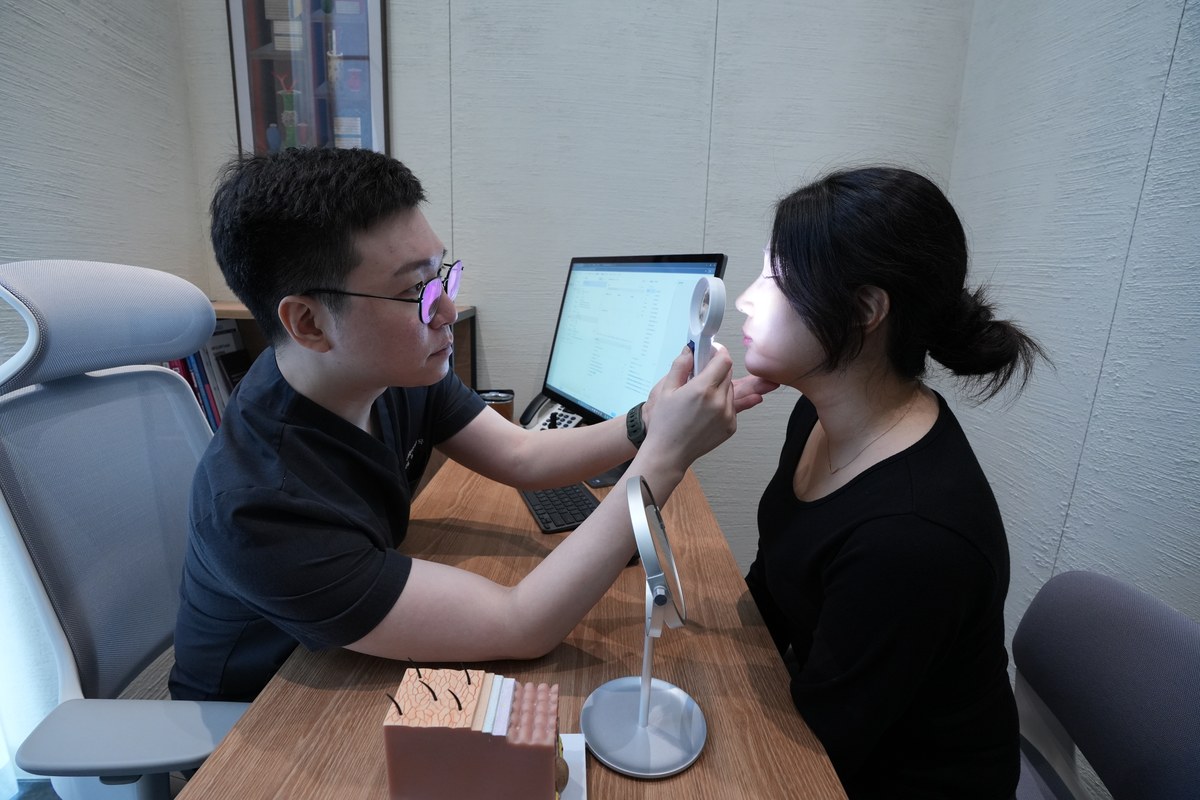
The order I check nose acne in at the consultation
I do not decide by looking at the nose alone. I look at the forehead and the jawline with it. If it is only on the nose I read it as a problem of structure in that spot; if the forehead and jawline have it too, I read it as one part of acne across the face. Those two start on different medication.
I also separate out whether what shows is mostly dark plugs or mostly red and painful lesions. If it is mostly plugs, I start with something that unblocks; if it is mostly red and painful, I start with something that brings inflammation down.
Then I ask how long it has been like this. Years in the same state is a question of setting a direction for care; a sudden worsening over the past few months means looking for what changed. Usually something has, among cosmetics, medication or the hours being kept.
When I do not recommend a procedure for nose acne
There are days I do not raise lasers or procedures at all. That is when several red, painful lesions are up at the time. Putting a procedure on top of active inflammation keeps the marks for longer.
On those days I bring the inflammation down first with a topical and, if needed, an oral medication. Afterwards I look at what marks and depressions are left and decide on a procedure then. Reverse the order and the procedure gets done twice.
The other way round, staying on acne medication alone when the inflammation has fully settled and only marks are left is not right either. Whether what remains is pigment or a depression changes what comes next.
Frequently asked questions
Is it all right to squeeze nose acne?
What has an open surface and looks like a dark dot is cleared by extraction in the clinic. Anything red, firm and painful when pressed has no way out yet, so pressure spreads it into the surrounding tissue. The rule is that painful ones are left alone.
Why does acne appear only on my nose?
The nose has the highest follicle density on the face. More channels means more places to block. It is closer to a question of structure in that spot than of not washing enough.
The redness lasts a few days after extraction. Is that normal?
Extraction clears the blockage and leaves irritation in its place. The redness is that response and usually settles within a few days. The more that is taken out at once, the longer it stays.
Do pore strips or scrubs help?
They lift off what has already surfaced and leave what is blocked underneath as it was. The surface is stripped in the process, which makes starting a topical more painful.
Can nose acne leave scars?
It can. The skin there is thick and rich in sebaceous glands, so inflammation settles deep easily. Where something painful has been squeezed repeatedly, or the same spot has been coming up for months, I bring the inflammation down before extracting.
Will washing more often improve it?
Strip the oil and it comes back in proportion. Twice a day is enough, and not skipping the topical at night counts for more.
1 min walk from Dunchon-oryun Stn. Exit 1 (Line 9)
Tel 02-488-9119