
Does treating melasma aggressively make it darker?
"I had a course of treatment and the melasma got darker." Answering that means going back to what melasma is. It is not simply accumulated pigment; the cells that make pigment are themselves overactive. That difference changes the direction of treatment.

A factory and a delivery network
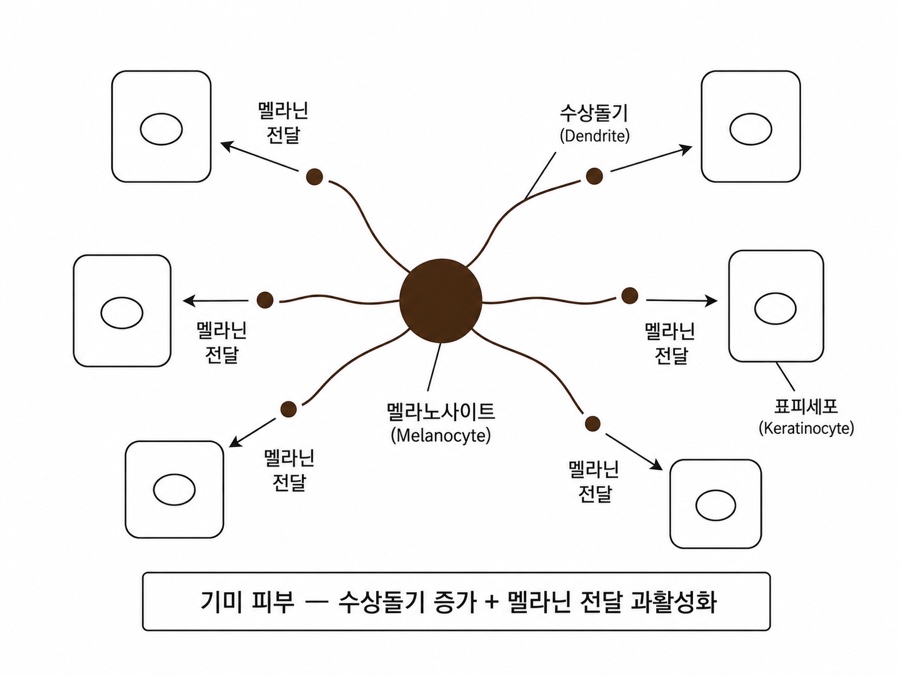
Melanocytes in the skin produce melanin and pass it to surrounding cells through dendrites that branch out like twigs. The melanocyte is the factory; the dendrites are the delivery network.
In skin with melasma that network runs harder. The dendrites increase or lengthen, and melanin transfer becomes much more active than usual.
So the aim is not to remove as much pigment as possible. It is to bring excessive melanocyte activity back to normal.
What the laser does
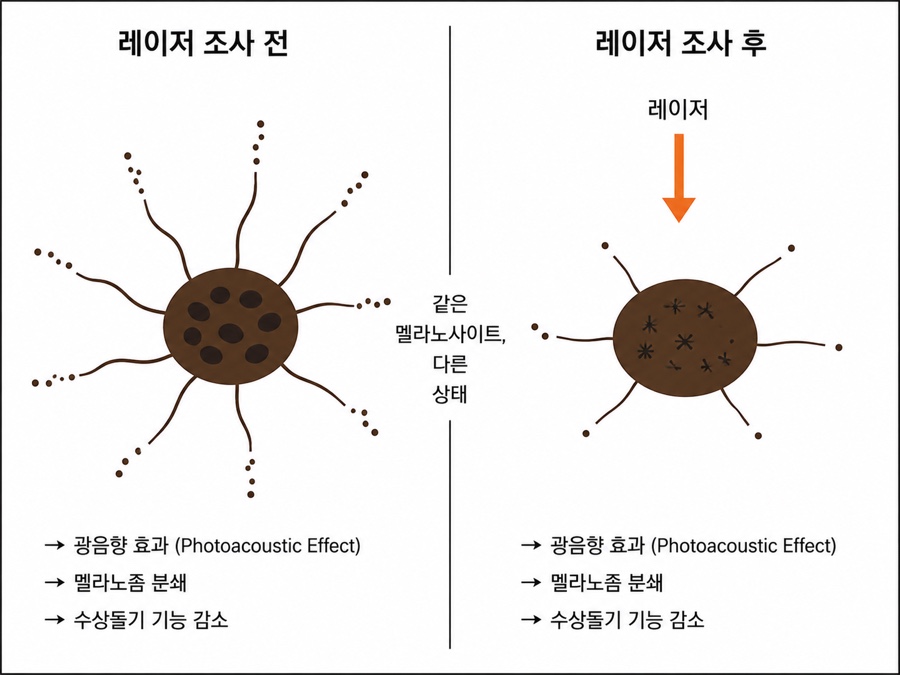
When the laser reaches the skin, melanosomes(the small packages holding melanin)absorb the energy. A photoacoustic effect fragments them finely, and at the same time dendrite function falls, so melanin transfer itself decreases. The pigment is broken up and the delivery network is tidied.
Pulse width matters here. A melanosome is a very small structure, so energy has to be delivered in an instant, before it spreads. That is why Q-switched and picosecond lasers are used for melasma.
Why stronger makes it darker
If energy is excessive or the exposure is too long, energy that should stay inside the melanosome spreads to surrounding tissue. Thermal damage follows, and that damage re-stimulates the melanocytes.
It is like trying to blow up the pigment factory and setting fire to the neighbourhood. The factory, stimulated, produces more pigment. This is rebound pigmentation: improvement for a while, then darker than before.
Melasma skin already has hypersensitive melanocytes. They respond more readily to stimulus, so aggressive treatment is more likely to backfire.
Three conditions for good melasma treatment
- Fragment the melanosome selectively: energy delivered precisely to the target
- Reduce dendrite function: regulating the transfer system, not only removing pigment
- Minimise thermal damage to surrounding tissue: the reason for short pulse widths
The aim is not to break up as much pigment as possible but to return a skin environment with overactive melanin production and transfer to normal.
Frequently asked questions
Does stronger treatment clear melasma faster?
No. Melasma skin has hypersensitive melanocytes that produce more pigment under strong stimulus. Aggressive treatment leading to rebound pigmentation is not uncommon.
Why does thermal damage make it worse?
Excess energy causes thermal damage to surrounding tissue, and that damage stimulates the melanocytes, promoting pigment production instead.
Q-switched or picosecond?
Both deliver energy in short pulses. Picosecond is shorter and can reduce thermal damage further. Which suits depends on the state of the melasma and the skin type.
Does melasma go away completely?
It is better approached as management than removal. The melanocytes do not disappear, and without sun protection and lifestyle management it can return.
How is it different from pigmentation?
Pigmentation is a temporary increase from an external stimulus such as inflammation or UV. Melasma is a chronic state in which the melanocytes themselves are overactive.
1 min walk from Dunchon-oryun Stn. Exit 1 (Line 9)
Tel 02-488-9119