
Brown marks and red marks: why the treatment differs
"I have had laser several times and the acne marks are still there." Most often the cause is not the device but the diagnosis. What look like one problem are usually two different lesions wearing a similar appearance.

Acne marks are not one problem
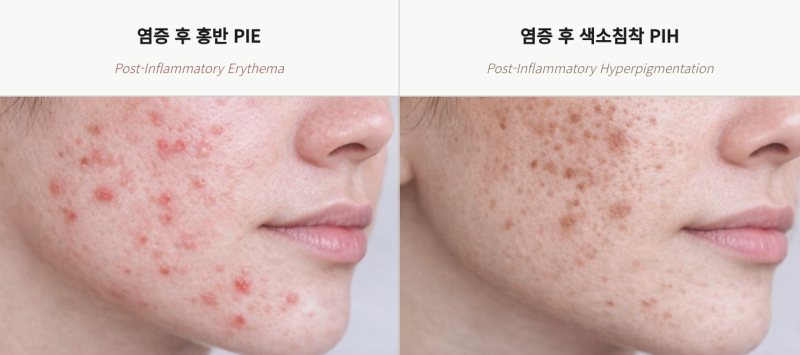
Brown marks: post-inflammatory hyperpigmentation (PIH). Melanin deposited in excess. Brown or greyish-brown, and it tends to darken with sun exposure.
Red marks: post-inflammatory erythema (PIE). Capillaries left dilated. Red or pink, and the colour fades briefly when you press it.
They differ in cause and in the laser they need. Repeating the same treatment without distinguishing them can leave the result short of what was expected.
Telling them apart
A specialist assessment is most accurate, but there are simple checks.
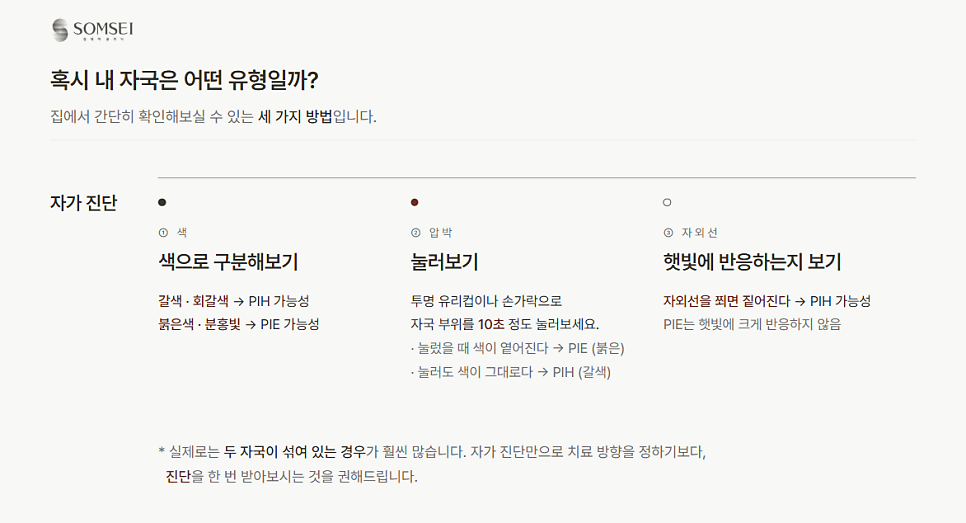
- Colour: brown or greyish-brown suggests PIH; red or pink suggests PIE
- Pressure: press the area with a finger or a clear glass for about 10 seconds. If the colour fades, PIE is likely; if it stays, PIH is likely
- Sun: if it darkens with UV exposure, PIH is likely
In practice the two are mixed far more often than not, so treat self-assessment as a reference rather than a decision.
How brown marks form
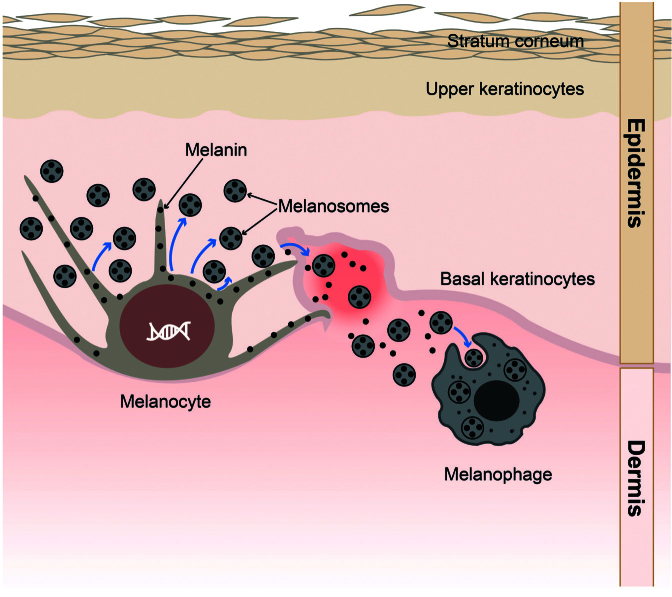
Acne is inflammation in the skin. Inflammation signals injury, and the pigment cells become more active than they need to be. The melanin produced is passed to surrounding cells one by one, so the whole area where the inflammation sat gradually darkens.
Where inflammation was severe, melanin can descend into deeper layers. Pigment settled that deep is not reached by brightening cosmetics or light care. That is why one mark seems not to move however much you look after it.
The first step is not laser
It is sun protection and topicals. Tranexamic acid, azelaic acid, hydroquinone and retinoids are used to block the signal that produces more melanin. Go straight to laser without this step and the rate of clearing struggles to keep up with the rate of re-deposition. Toning becomes meaningful once the skin is stable, and the principle is low energy repeated, not strong once.
Clinical work has shown that the stronger the inflammatory stimulus, the worse the PIH. Choosing an aggressive treatment to clear a mark faster can re-stimulate the pigment cells and slow the result. From the skin’s point of view it has been threatened again.
Korean skin carries more melanin than Western skin. Dermatology classifies skin into six Fitzpatrick types by lightness, and Korean skin sits above the middle. Applying a laser protocol built around Western skin unchanged carries a greater risk of pigment stimulation, which is why low energy repeated is generally recommended here.
Why red marks persist
As acne inflammation settles, the dilated capillaries should return to size. If angiogenic factors were released in excess during the inflammation, the vessel wall can be left damaged and fixed in a dilated state. Those altered vessels remain near the surface and show through as red. PIE is a structural problem, not a pigment problem: which is why a picosecond laser targeting melanin does little for it.
Treating red marks
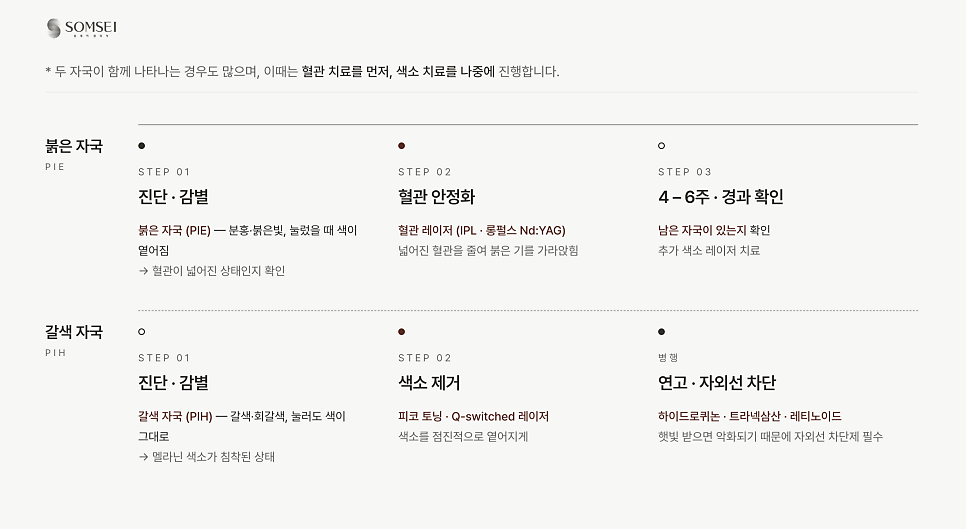
Red marks need a laser that selectively contracts vessels. Pulsed dye laser responds to haemoglobin and targets superficial capillaries. IPL is used for broader erythema and in mixed PIE and PIH cases. Long-pulsed Nd:YAG reaches deeper vessels.
One point matters: PIE responds better the earlier treatment starts. Once the vessels have fully established, the contraction response tends to fall. Waiting for it to fade on its own often means more sessions later.
When both are present, order matters
In real skin one type alone is rare. PIH and PIE are usually mixed, and rather than treating both at once, it matters which to stabilise first.
Where PIE dominates, the dilated capillaries are treated first. Once the redness settles, the extent of the remaining pigment can be assessed more accurately, and toning is added four to six weeks later if brown remains.
Where PIH dominates, sun protection and topicals come first, then low-energy toning once the skin is stable. Going straight to laser can re-stimulate the pigment cells.
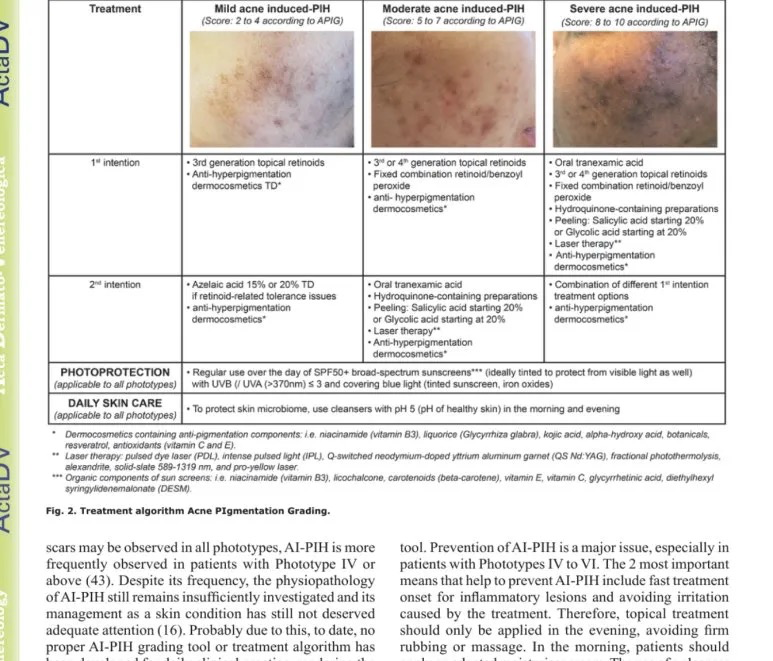
A 2025 study in Acta Dermato-Venereologica staged acne-induced PIH by severity: mild is centred on retinoids and pigment care; moderate adds hydroquinone, glycolic or salicylic peels and laser; severe extends to oral tranexamic acid and combination treatment. SPF 50+ and a pH 5 cleanser are the baseline at every stage.
That is, darker pigment does not call for a stronger treatment. The principle is to adjust the intensity of the approach in stages.
When atrophic scars are also present
Atrophic scars(ice pick, rolling, boxcar)often hide beneath the marks. Manage the pigment and the vessels and shadows still form at certain angles, so it can still read as a mark. Toning or vascular laser alone has limits here; dermal remodelling has to come first or run alongside.
The mixed case of brown marks, red marks and atrophic scarring together is common. A single approach built around one type leaves the others in place. In such cases what matters is less which device was used than which combination in which order.
Diagnosis first
Treating acne marks is less a question of what to treat with than what is being treated: pigment, vessel or structure. When that is unclear, changing devices only adds sessions.
Frequently asked questions
Will they fade on their own?
Red marks often improve over months. Brown marks can darken if left without sun protection. Establish the type before deciding when to treat.
How many sessions?
It depends on type, depth and skin type. PIH generally needs repeated toning, PIE several vascular laser sessions, and a mixed case with atrophic scarring needs staged planning.
Which comes first if both are present?
If PIE dominates, vascular laser first, then pigment care. If PIH dominates, sun protection and topicals first, then toning.
1 min walk from Dunchon-oryun Stn. Exit 1 (Line 9)
Tel 02-488-9119